Find product improvements beyond package.json
Track hosted APIs, platform settings and account-level capabilities that can improve your product without a change in its package manifest.
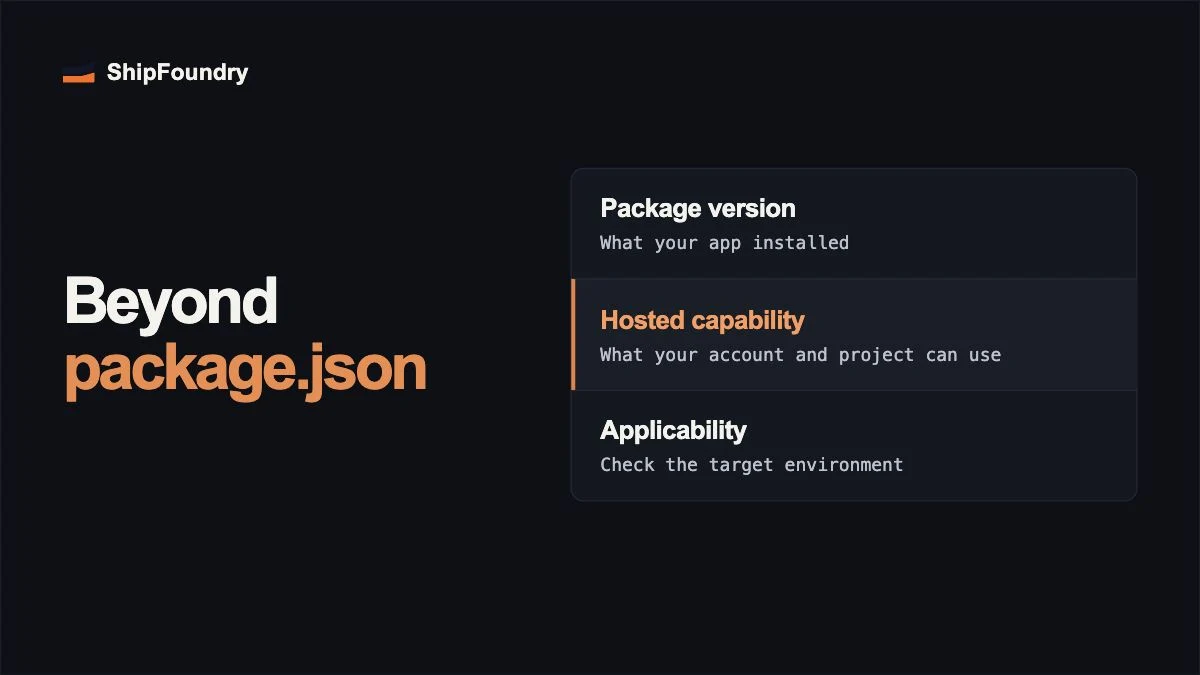
Imagine your dependency bot has finished its work. The lockfile is current, the tests pass, and the app still uses a copied SDK key so one Vercel project can read rollout flags from another. Then Vercel introduces a way to connect those projects without sharing the key. Nothing about a green dependency pull request tells you whether the new arrangement fits your application.
Monitoring third-party API and platform changes requires more than tracking package versions. Keep the dependency process, but add the remote services your product relies on, the authoritative places where they announce capabilities, and the account and implementation facts that determine whether a change is useful. Use that evidence to identify a plausible product improvement your agent can investigate.
This guide gives you a coverage map, an applicability worksheet, and a worked example. Scope: This is a documentation-based analysis, with primary sources checked on November 9, 2026. The Vercel application below is hypothetical. No customer integration, account configuration, or ShipFoundry-generated result was tested.
What a clean dependency update actually tells you
A package.json entry describes a declared dependency and permitted version range. A lockfile helps establish the resolved package version. SDK release notes explain new client methods, fixes, and compatibility changes. Dependency pull requests and their tests are useful evidence that local software can be updated safely within the scope tested.
Keep that process. It answers an important question: What code have we installed?
It does not, by itself, answer other questions: Which API version receives a particular request? Has an account enabled a hosted feature? Do production and preview deployments see the same configuration? Does the product still maintain a workaround the provider can now replace? A repository-aware agent can inspect many implementation details with permission, but some answers live in a provider account, deployment, or product decision rather than a manifest.
Nor is this a clean division between local and remote changes. A hosted capability can require a newer SDK, and an SDK update can select a different remote API version. You need both kinds of evidence.
Where a useful capability can appear
Start with the services behind critical product workflows: payments, customer email, rollout controls, and model-powered features, for example. Do not inventory every tool the company has ever purchased. Each surface below is a place to look for an improvement, not a promise that every change is relevant.
| Surface | Primary evidence | Applicability question | Possible product consequence |
|---|---|---|---|
| Local dependency | Manifest, lockfile, SDK release notes | Does the resolved SDK expose the needed feature? | Adopt a supported client capability. |
| Remote API | Provider version docs and request configuration | Which API version serves calls and events? | Simplify a payment workflow. |
| Hosted platform | Platform changelog and deployment/account settings | Are both projects eligible and connected? | Share rollout flags without copied keys. |
| Model service | Endpoint/model docs and real workload | Is the model available for this endpoint and tier? | Improve quality, speed, or cost if tests agree. |
| Integration pattern | Docs for existing parts and product architecture | Can supported pieces work together here? | Replace glue code or add a useful workflow. |
The first four surfaces can be grounded in provider documentation. The last is a design inference: sometimes the opportunity is a better combination of capabilities you already have, not a newly released endpoint. The possible consequences are examples, not measured results. Stripe's API versioning, Vercel's Project Connections, and Resend's Inboxes announcement illustrate why these sources differ.
Stripe shows why two kinds of version can coexist
Stripe is a good counterexample to the idea that the SDK is irrelevant. Its SDK versioning documentation says each SDK release uses the API version current when that SDK was released. For stripe-node v12 and later, the SDK's API-version association matters for requests and TypeScript types; explicit overrides are possible but can make those types inaccurate. Older SDK versions may behave differently. Check the language and SDK generation you actually use.
Now consider a different request path. According to Stripe's API versioning documentation, direct curl requests use the account's default API version unless the request overrides it. Webhook events can use the API version configured for their endpoint, or the account default when one was not set. A current Node SDK does not, on its own, establish the version for a separate direct HTTP client or an existing webhook endpoint.
For a payment integration, inspect the resolved SDK version, the effective version on each request path, the webhook endpoint configuration, and the feature actually used. If a version change is warranted, follow Stripe's integration upgrade guidance and test the affected paths. Do not treat changing a header or updating a package as a universal migration recipe.
Worked example: a Vercel platform update that could remove a workaround
On November 2, 2026, Vercel announced Flags Project Connections. The feature lets a project evaluate flags owned by another project in the same Vercel team using the consumer deployment's identity rather than a shared server SDK key. The implementation documentation describes connection setup, supported libraries, access, and environments.
Consider this illustrative application:
checkoutowns a flag that controls a coordinated rollout.storefront, a second Vercel project in the same team, evaluates that flag.- Today, someone copies a server SDK key into
storefront's environment and maintains that arrangement manually. - The product goal is to preserve the coordinated rollout while removing that particular key-sharing step.
The announcement makes that a candidate improvement. It does not establish that the hypothetical application is configured correctly, that its existing SDK can use the feature, or that the work is worthwhile.
What an agent should establish before suggesting a change
Project and library fit. Are the source and consumer projects in the same team? Does the consumer really use a copied SDK key? Is Project Connections already configured? At the time of this review, Vercel documents @flags-sdk/vercel 1.6.0 or later for the adapter, or @vercel/flags-core 1.11.0 or later when using the core library directly. Check the resolved installed version, not merely a declared range.
Access and environment fit. A connection grants read and evaluation access to all flags in the source project, across all environments, including configuration and targeting-rule data. It cannot be limited to a single flag or environment. The consumer deployment determines which source environment is evaluated. Local development uses a different token setup from a deployed application, and connection management requires the documented permissions. These constraints may rule out an otherwise attractive change. See Vercel's scope and permissions documentation.
Product fit. Do both applications need to use the same rollout flag? Is the current key distribution a meaningful maintenance task? Would the broader read scope be acceptable? Flag evaluations still count toward the source project's usage. Replacing key sharing is not the same as eliminating flag management or all credentials.
The decision is conditional
If the projects are in different teams, the documented Project Connections model does not fit that arrangement. If the consumer already uses connections, there may be nothing to adopt. If the SDK is too old or the access scope is unacceptable, the proposal is blocked until those prerequisites are resolved or the team chooses a different approach.
If the prerequisites pass, use isolated source and consumer test projects in the same team, with only test flags and targeting data in the source. Evaluate one shared flag and record the configuration, environment mapping, fallback behavior, and key-sharing task the change could remove. A preview deployment or single test flag does not narrow the connection's project-wide access. Create the connection only within the authority granted for the experiment. No such experiment was performed for this article.
The investigation should establish whether this product benefits from changing how it shares rollout flags.
A remote capability can change the product design, too
Resend's October 22, 2026 Inboxes announcement describes hosted email inboxes with conversation threads, reply APIs, drafts, labels, and agent-facing workflows. That offers a different design choice from receiving individual email events and building all conversation state, routing, and reply handling yourself.
A product with a simple incoming-email webhook may have no need for a managed inbox. Another product might benefit from replacing custom thread management. Either way, the next questions are about existing behavior, supported integration paths, availability to the account, permissions, and which custom behavior must remain. The current SDK version alone cannot decide. This is a possible architectural change, not a claim that migration would be effortless.
Build a small coverage process
Choose three to five external services tied to outcomes you care about. For each, record the workflow it serves, the vendor's authoritative changelog or technical documentation, the relevant API or SDK path, who can verify account settings, and what improvement would matter. A payment provider might matter because checkout completion is a priority; a model API might matter because a specific task is too slow or expensive. An unrelated announcement can be ignored.
When an interesting change appears, use this worksheet before assigning implementation work.
Check whether the capability applies
| Question | Evidence to inspect | Resulting decision |
|---|---|---|
| Local library | Resolved lockfile version and provider SDK requirements | Upgrade the client only if needed. |
| Remote version | Effective version for requests, events, and endpoints | Determine API fit and migration needs. |
| Account access | Entitlement, team relationship, and active feature settings | Confirm eligibility; ask the owner if unknown. |
| Environment | Deployed identity, configuration, and environment mapping | Test in a representative nonproduction setup. |
| Existing behavior | Current code, deployed settings, and workarounds | Replace, retain, or stop if already adopted. |
| Product value | Product goal, affected users, effort, and risks | Pursue only when benefit justifies change. |
Check availability, configuration, and product value separately. If the answer depends on a private account setting, preserve it as a question for the person who can verify it. And if the provider has already made an improvement automatic, simply confirm that behavior and move on.
Choose a sufficient way to follow these changes
| Approach | Strongest fit | Work you still own |
|---|---|---|
| Vendor sources | A few stable services with clear release channels | Subscribe, read, and connect changes to goals. |
| Page monitor | Selected changelog or documentation pages and change history | Choose pages, filter edits, and assess impact. |
| API diff | Published machine-readable specifications for contract changes | Compare versions and assess non-schema changes. |
| Configured agent | A team already maintaining sources and product context | Maintain inputs, permissions, prompts, and scheduling. |
| ShipFoundry | Recurring product-opportunity triage across supported sources | Confirm coverage and context; have your agent verify and execute. |
These approaches can work together. For example, Domscout documents rendered-text change detection and webhook delivery for selected vendor pages. ChangeTower describes filters for release notes and API documentation. A monitor tells you that source content changed; it does not automatically prove that a new capability is deployed or valuable to your product. Depending on configuration, monitoring tools can also provide summaries and relevance filters.
An API specification diff is effective when the published specification captures the relevant contract. It can miss a new account setting, a platform connection feature, or a useful combination of existing capabilities. A well-configured existing agent can combine vendor feeds with your product context and make these judgments without another subscription, provided someone maintains that workflow.
ShipFoundry instead focuses on qualifying changes across the sources it covers against a confirmed product profile, goals, constraints, and stack, then supplying a source-linked opportunity for the customer's agent. Its agent workflow documentation describes handoffs through MCP, API, CLI, and other supported routes. Coverage is not every vendor page. ShipFoundry does not verify your live codebase for each candidate or independently schedule, implement, test, and deploy the work; your agent and permissions remain responsible for that.
Hand one source-backed opportunity to your agent
Here is a compact handoff using the hypothetical Vercel case. The headings can be reused for any hosted service:
Source: Vercel's November 2, 2026 Project Connections announcement
        and current Project Connections documentation.
Capability: A consumer project can evaluate source-project flags
            using deployment identity instead of a shared SDK key.
Product benefit: Keep one coordinated rollout while removing manual
                 server SDK key sharing for this connection.
Current implementation evidence: Hypothesis only. Inspect both projects,
                                 resolved adapter version, and config.
Eligibility questions: Same Vercel team? Existing connection? Required
                       permission? Acceptable all-flags read scope?
Smallest plausible change: Use isolated test source/consumer projects in
                          one team; keep only test flags and targeting data
                          in the source. Set a fallback and use authorized access.
Access boundary: Testing one flag or using preview does not restrict the
                 connection's access to the source project.
Verification: Compare expected flag evaluation before and after, confirm
              environment mapping, and identify the exact key task removed.
Stop if: Already adopted, not eligible, access too broad, or no product value.
The agent should return evidence and a recommendation before changing production configuration. If it finds the improvement already adopted, record that and close the investigation. An owner's confirmation of a project fact is not blanket permission to change code or external accounts.
What to use next
If you rely on three predictable providers and already read their updates, a short source list plus your existing agent may be enough. Choose a page monitor when capturing changes to arbitrary vendor pages is the immediate problem. Add API diffs when versioned machine-readable contracts are central to the integration.
Consider ShipFoundry when the recurring difficulty is deciding which supported external changes could improve your particular product and passing one worthwhile lead into an agent workflow. Keep dependency updates and operational monitoring regardless. The measure of success is a sound decision, including a justified rejection, followed by a verified improvement when one is appropriate.
Frequently asked questions
Does upgrading an SDK expose every new API capability?
No. The SDK may expose client methods and select an API version, but a hosted feature can also depend on account access, request configuration, deployment settings, or a separate webhook version. Stripe's SDK and API versioning pages show why you must inspect the actual path.
Can a remote feature still require a package update?
Yes. Vercel's Project Connections documentation specifies minimum library versions for supported integration paths. Check both provider eligibility and the resolved local library before assuming you can enable a feature without code changes.
What if I call an API directly without its SDK?
Check the endpoint's official versioning rules and your actual request headers or client configuration. For example, Stripe documents how a direct curl request uses an account default or explicit version header. Do not infer direct HTTP behavior from an SDK package that the request never uses.
How can I tell whether a platform improvement is already active?
Inspect the provider's account or project configuration, deployed environment, and the current application path. Then verify the behavior in a safe environment. A release announcement establishes that a capability was announced, not that your account is using it.
What if ShipFoundry does not cover one of my services?
Keep that service's primary changelog or documentation in your own source list. Use a page monitor, an API-specification diff, or a configured agent where appropriate; do not assume ShipFoundry watches arbitrary URLs. You can still apply the worksheet and handoff format yourself.
Ready to look beyond the manifest? Find improvements across your stack: describe the services your product actually depends on and the outcomes you want, then give your existing agent a relevant opportunity to investigate. Confirm the source, eligibility, and product benefit before making changes.