From dependency updates to product improvements
Use Dependabot or Renovate to maintain dependencies, then evaluate which new capabilities could improve your product’s features, reliability or costs.
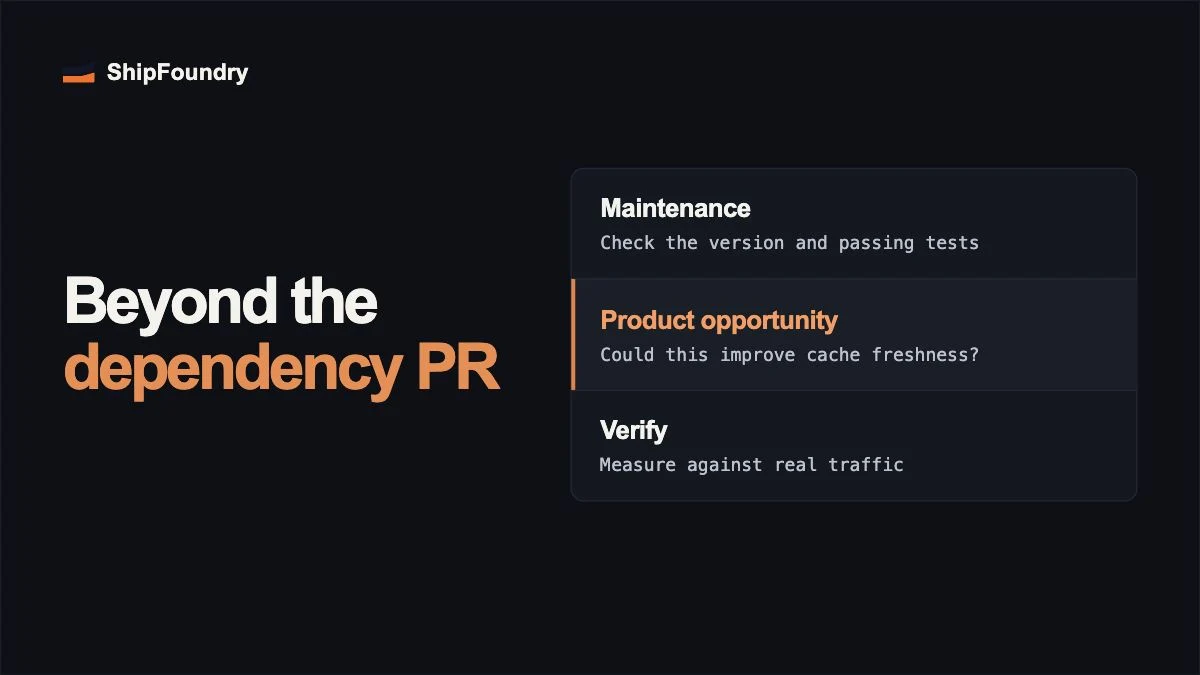
A Dependabot or Renovate pull request gets merged. The tests pass, the application still works, and the dependencies are current. That is a useful maintenance result. It does not tell you whether the release also made a better product experience possible.
Keep Dependabot or Renovate for dependency maintenance. Add a separate product-opportunity decision when a relevant change could advance a goal. Have a coding agent inspect your application before adopting the capability, then verify the resulting behavior. If the release already delivers its benefit, the capability is in use, or it does not matter to the product, there is no extra task to create.
ShipFoundry can help make that recurring decision across the tools your product uses, alongside the dependency bot and coding agent you already have.
Research scope: Official GitHub, Renovate, Next.js, Resend, and ShipFoundry documentation checked on November 9, 2026. The examples below are illustrative. No hands-on benchmark, customer outcome, or cross-product test was performed for this article.
What a dependency-update PR already does well
Dependabot version updates identify newer supported dependency versions and raise pull requests. GitHub distinguishes those from security-update PRs, so Dependabot is not just a vulnerability alert system. The version-update workflow can put release notes and changelogs beside a proposed manifest change for review.
Renovate also prepares dependency and lockfile PRs. It can discover package files, schedule updates, apply shared configuration, and, for supported managers, propose replacements for deprecated dependencies. Both tools can support a serious maintenance process. Their actual configuration, coverage, and review controls matter more than a blanket winner.
A solid maintenance loop is already valuable: review the change and upstream guidance, run tests and compatibility checks, pay attention to security implications, and merge or defer with a reason. A necessary security fix or reliability update should not wait for a separate product-feature justification. And passing tests are useful evidence, not a universal guarantee of safe operation.
If you are choosing between the bots, start with the GitHub configuration guidance and Renovate documentation. This article addresses a narrower question: what should happen after an update, or after an external change that creates no update PR at all?
What still needs a product decision
A release may do one of three things:
- Improve the product without application work. A fixed default or compatible performance change might take effect when the update is deployed. Verify the actual behavior, but do not invent a follow-up feature ticket.
- Make an improvement possible. A framework primitive, API field, or new integration option may require configuration, application code, a changed workflow, or user-facing design before anyone benefits.
- Change nothing worth adopting now. The product may already use the capability, have a better existing approach, or lack a relevant need.
Ask: "What could this product do better because of this release, and is that worth the work?" A small change can remove a long-standing workaround. A major release can be mostly irrelevant to the customer experience. The right answer can also be no action.
Use three connected stages
From maintained dependencies to a useful change
| Stage | Input | Useful output | Evidence still needed |
|---|---|---|---|
| Dependency maintenance | Manifest, available release, and update PR | Reviewed update or maintenance decision | Tests, compatibility, and security review |
| Capability assessment | Source change and a current product goal | Adopt, investigate, or no action | Actual code path, constraints, and payoff |
| Product verification | Approved change or no-action decision | Recorded behavior or justified decision | Freshness, reliability, and user impact |
The first stage is the domain of tools such as Dependabot and Renovate. The second and third rows describe the application decisions and verification that still need an owner. One competent coding agent can help with all three, subject to your normal permissions and review.
The handoff from maintenance to assessment should contain the specific upstream change, the installed or proposed version, and the product goal it might affect. The handoff to implementation should add an applicability finding, the smallest plausible change, a stop condition, and checks that would prove or disprove the benefit.
Worked example: an available caching capability needs an application choice
Consider a hypothetical SaaS catalog built with the Next.js App Router. Public category pages make repeated data reads, and the team suspects those reads contribute to slow browsing. Nothing has been measured for this example.
The current Next.js caching documentation describes Cache Components configuration for existing apps; new App Router apps created with the current defaults already enable it. With a supported configuration, use cache can cache an eligible async function or component. Revalidation can follow a lifetime or an on-demand invalidation strategy. Match that strategy to the freshness requirement: stale-while-revalidate can return an older value while refreshing it, whereas immediate read-own-writes needs the appropriate immediate-expiry behavior. Check the application version, cache boundary, and deployment before choosing an implementation.
A dependency update may make those APIs available, but it does not choose where caching belongs. The agent first needs to establish whether the application already caches the catalog effectively. It must also distinguish public reusable data from private or rapidly changing data. If item details change, what delay before the new value appears is acceptable? A faster response that shows out-of-date information may be a regression, not an improvement.
A sensible investigation has five steps:
- Check the prerequisite. Confirm the installed Next.js version, App Router usage, configuration, and existing caching behavior. Do not assume a merged PR enabled the desired feature.
- Choose one narrow candidate. Locate a public, frequently reused read or component, and exclude request-specific private data.
- Define the product contract. Specify the experience to improve and a freshness requirement before editing code.
- Test a bounded change. Compare the same cold and repeated requests before and after the change, and change a catalog item to verify that updates appear as required. Record any errors and regressions.
- Accept or reject the work. Keep the change only if the evidence supports the goal. If existing behavior already meets the requirement, record no action.
That investigation can start with the coding agent you already use. Here is a prompt you can adapt without ShipFoundry:
Product goal: Improve responsiveness when visitors browse repeated public
catalog pages, while keeping updates within the agreed freshness window.

Primary source: https://nextjs.org/docs/app/getting-started/caching
Related source: https://nextjs.org/docs/app/getting-started/revalidating

Before editing:
- Confirm our Next.js version, config, current cache behavior, and data flow.
- Identify one eligible public read and the relevant mutation/invalidation path.
- State the freshness requirement and how we will test it.
- Check whether the existing implementation already meets the goal.

If the case is worthwhile, propose the smallest bounded change. Implement
within the authority already granted, or identify the approval still needed. Compare the same workload before and after;
test a data-update case; record regressions. Return the source, inspected
files, decision, test evidence, and whether adoption is justified.
If there is no benefit, recommend no action instead of creating work.
This investigation tests whether caching would help this catalog. The agent must inspect the real application to choose the version-specific implementation.
A second case can arrive without a package PR
On July 8, 2026, Resend announced that its email webhooks and sent-email retrieval endpoints include message_id. Its announcement describes how the identifier can help connect an inbound reply to the original outbound message and support email threading.
Imagine a product that already sends notifications but handles replies as unrelated messages. It could investigate whether the new field helps link those replies to the right conversation. That possibility can arise from a hosted API response change even when package.json is unchanged.
It still needs product work: retaining identifiers, matching and validating inbound messages, deciding what the conversation should look like, and checking the account's actual integration. A typed client might also need an SDK or type update. The remote field is evidence of a possibility, not proof that threading now works automatically. The general lesson is that your opportunity review cannot stop at dependency PRs.
Decide whether an extra opportunity step is useful
When to add a product-opportunity step
| Situation | A sufficient starting approach | Reason to add more context |
|---|---|---|
| Routine version maintenance | Keep bot PRs, CI, and normal review | Only if the release suggests a useful new capability |
| A known feature already on the roadmap | Give the existing agent a scoped task | If prerequisites or source changes remain unclear |
| An unfamiliar capability related to a current goal | Read the primary source and inspect applicability | If discovery repeats across tools or projects |
| A hosted service change without an update PR | Follow vendor announcements and check the API | If package-only monitoring misses relevant changes |
| Already-adopted or irrelevant functionality | Record no action and continue | Usually none; avoid duplicate work |
If you maintain one stable product and read release notes consistently, a short checklist may be enough. If your existing scheduled coding agent reliably connects releases to current goals and records decisions, keep that process. There is no reason to replace working automation merely to add another service.
The tradeoff changes when several frameworks, APIs, and infrastructure providers are moving at once, or when you maintain multiple products with different goals. Someone has to remember which changes might matter to each product, which questions are unresolved, and which ideas have already been ruled out.
ShipFoundry's product overview describes matching external changes against a confirmed project profile, stack, goals, and rules, then preparing a source-linked opportunity for an existing agent when a useful candidate qualifies. Through agent workflows, the builder can review those candidates, retrieve a handoff, and record what happened using an agent, MCP, API, or CLI.
Your agent establishes code-level applicability by inspecting the repository, then carries approved work through implementation, testing, and outcome reporting. ShipFoundry supplies the opportunity and handoff; execution and scheduling stay in your agent workflow. Dependabot or Renovate should continue doing the dependency-maintenance job.
Carry the improvement through to evidence
A useful outcome record should be short enough that someone will actually fill it in. For the hypothetical catalog, it could look like this:
- Goal: Make repeat public catalog browsing more responsive without breaking the agreed freshness rule.
- Source: The dated Next.js caching and revalidation documentation.
- Applicability: Installed version, existing cache path, reusable public read, and update/invalidation behavior confirmed or rejected by inspection.
- Decision: Adopt a narrowly scoped cache boundary, investigate a remaining unknown, or take no action.
- Verification: Compare a defined baseline and the same workload after a change; include a data-change freshness test and regression checks.
- Follow-up: Record what changed, where the evidence lives, what remains uncertain, and whether the original product goal was met.
That is a record template, not a completed test. A merged application PR establishes that code changed. It does not by itself establish a faster experience, better retention, or customer value. Likewise, a justified no-action finding is a completed product decision, not a missed opportunity.
If you want to make this repeatable, keep a small log of the source, product goal, eligibility finding, decision, and observed result. Review the log when a related capability appears so your agent does not rediscover the same rejected idea every week.
Questions about using these tools together
Should I replace Dependabot or Renovate with ShipFoundry?
No. Keep a working process for dependency PRs, security fixes, compatibility testing, and lockfile maintenance. ShipFoundry addresses a different job: identifying external capabilities that might create worthwhile product work and handing the investigation to your agent.
Does reading the release notes already solve this?
It can. If you consistently connect the notes to current product goals, inspect the useful cases, and record decisions, you already have the essential workflow. A separate opportunity system is useful only if it reduces recurring work or makes relevant possibilities less likely to be missed.
Will installing a newer package automatically improve the product?
Sometimes. Defaults, fixes, and compatible optimizations may take effect with no additional application change. Other capabilities require explicit configuration or code. Verify the observed behavior rather than assuming either outcome.
Can the same coding agent handle both jobs?
Yes. It can review a dependency PR using its existing repository permissions, then separately assess whether the release supports a product goal. Give it the original source, actual code context, acceptance criteria, and a clear approval boundary before implementation.
What if there is nothing worth adopting?
Record that the feature is already in use, irrelevant, premature, or not worth the migration cost. Keep the existing implementation. A useful review should reduce unnecessary work as well as identify good work.
Want to test this against your own stack? Find a useful improvement for your product. Start with the product's goals and current tools, review relevant opportunities with your agent, and keep Dependabot or Renovate handling maintenance.