ShipFoundry vs NewReleases: From Release Alerts to Product Improvements
Compare NewReleases alerts, APIs and webhooks with ShipFoundry’s product-specific discovery, and choose the workflow that fits what you want to build.
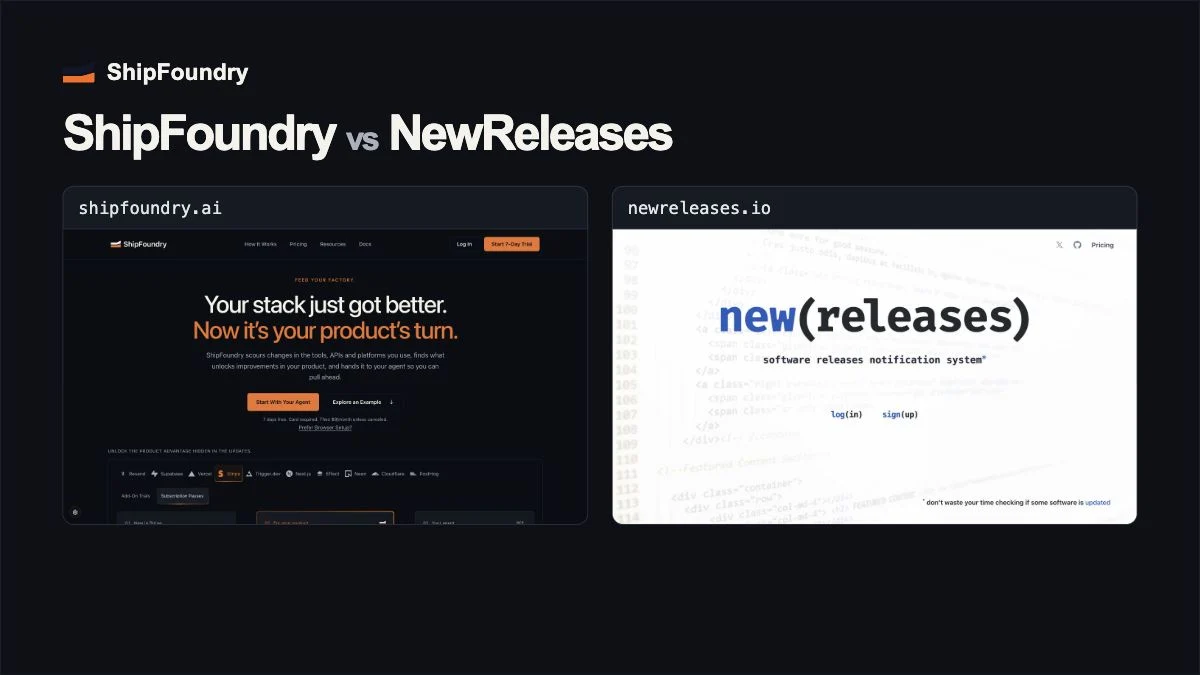
Short answer: Choose NewReleases.io when timely release alerts are the missing input to a review process that already works. Its listed features are free, including the API and webhooks. Evaluate ShipFoundry when the recurring gap is deciding which new external capabilities could improve your product, then handing a plausible task to your existing coding agent. The two services can coexist. If your current process already finds and advances worthwhile improvements, adding ShipFoundry may solve no problem.
Scope: This comparison was written by ShipFoundry from public product documentation checked November 9, 2026. It is a documentation-based analysis, not a hands-on head-to-head test. No customer deployment, speedup or savings was observed.
Capabilities at a glance
| Capability | NewReleases | ShipFoundry |
|---|---|---|
| Package and repository release alerts | ✓ Yes | ✗ No · Project discoveries |
| REST API and CLI | ✓ Yes | ✓ Yes |
| Native MCP server | Not documented | ✓ Yes |
| Match changes to product goals | Via your agent | ✓ Yes |
| Built-in code implementation | ✗ No | ✗ No |
NewReleases also offers signed release webhooks with optional tags and project notes. “Via your agent” means your workflow supplies the product goals and evaluates the alert. NewReleases features · NewReleases webhooks · ShipFoundry product overview
Start with the work you want to happen after an update
A new release is information, not yet a decision. For a team maintaining a SaaS product, the useful follow-up usually falls into three kinds of work:
- Necessary maintenance. An upgrade may be required by your own support, compliance or compatibility policy. That is real work even if it adds no new feature.
- A newly possible product improvement. A new framework or service capability may make the product simpler, more reliable or more useful. This is optional until its value and fit are established.
- No useful work right now. The change may be irrelevant, already adopted or inconsistent with what the application needs.
These are decisions about your product, not mutually exclusive labels for releases. One announcement may contain a maintenance item, a promising new capability and several changes worth ignoring. A well-maintained application can still miss a new product advantage. A team that tries every new feature can waste just as much effort.
The question worth adding to release review is: What could this change improve for our users, or in our ability to deliver this product? If you can answer that reliably from the alerts you already receive, keep the process.
What NewReleases already handles
NewReleases is a capable release-notification service, not merely an email digest. Its documented providers include GitHub, GitLab, npm, PyPI, Maven, Cargo, Docker Hub and others. You can import supported dependency files such as package.json, filter versions by regular expression or prerelease status, inspect release notes, and route notices to email or collaboration tools such as Slack and Discord. It also supports organizations and per-project notification preferences. Source: NewReleases features and pricing/features.
It is programmable. The HTTP API uses account API keys and documents rate limiting; the webhook integration sends release data to an endpoint you control and documents signature verification. Its site also lists a CLI. You could take a release webhook and ask your own agent to assess it against your product goals. That takes integration work, but it is a legitimate alternative to buying a separate discovery product.
NewReleases also stores project notes and tags, and its webhook payload can include project_note and tags. A NewReleases project is a tracked package or repository, rather than necessarily your whole SaaS product. Those fields can still carry useful context into your automation. Your own process decides how that context and the release affect the product.
Consider a team that imports its dependencies, receives a daily digest, triages changes against clear product goals and policies, and reliably gives worthwhile tasks to its agent. NewReleases already supplies the missing upstream information. ShipFoundry would have to demonstrate incremental value beyond that routine; prettier summaries are not enough.
The documentation establishes supported notification options, not a measured delivery-time guarantee. Check the actual source, filter and channel behavior against the tools you use before depending on any alert service.
What changes when the starting point is your product goal
ShipFoundry's product workflow starts with a confirmed description of what you build, why it matters, what you want to improve, and which tools and constraints apply. Relevant version context, answers and matching rules help it decide whether an external change implies a possible improvement for that product. An update without a qualifying opportunity need not become a recommendation.
For example, a goal like keep public documentation and pricing pages predictable and inexpensive to serve can make a new static-rendering guarantee interesting. A release item about an unrelated developer convenience might not matter. The proposed result is a concrete candidate for investigation, not a promise that the improvement is already valid or implemented.
This distinction has limits. You must supply or confirm accurate product context and a suitable watchlist. Source coverage varies. ShipFoundry does not continually inspect your repository for every update; optional read-only GitHub import provides initial context, and your coding agent checks the actual application. It can hand off an opportunity through copy, MCP, API, CLI or supported integrations, but your agent controls the investigation, code changes and execution schedule. An incorrect version assumption or an overlooked existing guard can still invalidate the idea.
Worked example: keeping public pages intentionally static
On October 6, 2026, the Next.js 16.4 announcement described ensureStatic, a route-segment setting for requiring selected server-rendered output to stay static. At its strictest navigation level, it can make a build fail when request-time behavior is introduced into a route that must remain fully static. Next.js also provides narrower shell and prefetch levels, along with its own agent-oriented upgrade guidance. ShipFoundry did not invent this framework capability or the upgrade tooling.
Now imagine a small SaaS with public documentation and pricing routes intended to be static, plus authenticated pages that intentionally show request-specific data. Its goal is to prevent an accidental change from making those public routes depend on request-time rendering. The possible product improvement is a build-enforced guard on suitable routes, not simply upgrading to the newest Next.js version.
Before proposing any edit, the team's agent should verify the actual installed and deployed versions, whether Cache Components is in use, which pages can satisfy a full-navigation static requirement, and whether an equivalent guard already exists. The current ensureStatic reference says the setting requires cacheComponents and must not be exported from a Client Component. The static-pages guide explains the navigation stages; the narrower shell guarantee also requires Partial Prefetching. Choose the level against the actual route requirements.
Three decisions from the same release
| Kind of decision | Example situation | Useful next action | Evidence needed |
|---|---|---|---|
| Necessary maintenance | An update falls under the team's stated patch policy (illustrative). | Schedule the required upgrade and regression tests. | Policy, actual version, release details, passing tests. |
| Newly possible improvement | Next.js 16.4 static-output enforcement might protect public pages. | Check prerequisites and test a route-level guard. | Rendering model, installed version, route behavior, build result. |
| No useful work now | A route requires request-time data or already has an equivalent guard. | Use a narrower guarantee or defer the change. | Dynamic requirements, existing protections, relevant tests. |
The categories may overlap. The maintenance example is an illustrative team policy, not a report of a vulnerability. The static-route example is a worked hypothetical: no repository was inspected, no ShipFoundry recommendation was retrieved, and no deployment, latency improvement or cost reduction was measured.
A bounded first task for the existing agent would be:
Check the application's actual Next.js version and rendering configuration against the official 16.4 documentation. Identify public routes intended to stay fully static and routes that need request-specific data. Determine whether an existing guard already covers the goal. If eligible, propose the smallest route-level
ensureStaticchange and a build check. Report prerequisites, tradeoffs and any failed build before asking to implement.
A personalized account route is a counterexample: it may need request-time rendering, so applying a root-layout navigation requirement indiscriminately would be inappropriate. If the public pages are already protected or the app does not use the relevant rendering model, no change can be the right result. The relevant outcome is the correct route decision, not whether the release gets adopted.
Compare the complete workflows
The fair comparison gives both approaches the same announcement, the same application goals, and access to a competent coding agent. The difference is which part of the process the service supplies. NewReleases' feature list, API and webhooks support the left column; ShipFoundry's product overview and pricing support the right.
| Workflow question | NewReleases plus your process | ShipFoundry plus your agent |
|---|---|---|
| Typical starting point | A tracked release and your existing review routine. | A selected stack change and a confirmed product goal. |
| Source fit | Git hosts, package registries, container and chart sources as listed. | Selected tools, services and technical changes; check coverage. |
| Existing project context | Tracked packages/repos, notes, tags and filters; your workflow applies product goals. | Confirmed product description, goals, stack, constraints and rules. |
| Automation access | HTTP API, signed webhooks and CLI; integrate your agent. | MCP, API, CLI and copyable handoffs; agent runs externally. |
| Relevance decision | Your people or agent interpret the alert for your product. | Product-specific candidate matching; your agent verifies it. |
| Service price / unit | All listed features free; you fund any custom agent work. | Dev $9/mo: 1 project, 20 tools; Portfolio $19/mo: up to 5 projects, 60 shared slots. |
| Who implements | Your team or agent investigates, tests and ships. | Your team or agent investigates, tests and ships. |
NewReleases plus a webhook and your own product-context prompt can cover much of the reasoning step. That option gives you control and avoids another service fee, but you maintain the integration, prompts, context and review cadence. ShipFoundry packages recurring product-opportunity selection and the handoff, while leaving technical verification and execution to your agent. Neither path makes implementation automatic.
Free alerts, paid discovery, and what you actually pay for
As checked November 9, 2026, NewReleases lists all features as free, without a required card; it accepts donations. That is meaningful if your goal is to track releases and deliver them to your team or automation. A custom webhook receiver and agent can still consume engineering time and model usage, even when the notification service has no subscription fee.
ShipFoundry's current pricing page lists Dev at $9 per month for one project and 20 tracked tools, and Portfolio at $19 per month for up to five projects and 60 shared tracked-tool slots. Tracking one tool for two products uses two slots. These are product allowances, not a promise that every source has complete history. Your existing agent's investigation and implementation costs remain separate.
The relevant buying question is not whether ShipFoundry can replicate a free alert. It is whether its recurring product-specific selection uncovers useful work that your current process is missing often enough to justify the fee and setup. No time-saved percentage or return on investment has been measured for this comparison.
Keep NewReleases, add ShipFoundry, or make no change
Keep NewReleases as your main tool when you need broad release visibility across its supported providers and your team already makes sound decisions after the alerts arrive. Its filters, delivery channels and API are meaningful strengths, especially at its documented price.
Evaluate ShipFoundry when you already have an agent that can build changes, but useful capabilities often fail to turn into product-level investigation because no one connects them to your goals. Check first that the services you depend on are covered and that you can supply a sufficiently accurate product profile.
Keep both when NewReleases powers your maintenance inbox while ShipFoundry explores a narrower set of changes for features, reliability, operating costs or developer workflows. Or keep NewReleases and build a context-aware agent step yourself if you want that control.
Make no change if your existing process consistently produces the right amount of maintenance and improvement work. Neither adding a paid service nor automating more alerts is inherently progress.
Practical questions before choosing
Is NewReleases free?
Yes. Its pricing page, checked November 9, 2026, lists all features free with no required card and an option to donate. Any infrastructure or coding-agent usage you add downstream is separate.
Does NewReleases support APIs and webhooks?
Yes. It documents an authenticated HTTP API, signed webhooks, and a CLI. These are viable inputs to an agent process you build or operate.
Does ShipFoundry replace my update bot?
Not necessarily. NewReleases is well suited to delivering notifications; ShipFoundry tries to identify changes that could improve the particular product you are building. You may want alerts, product-opportunity selection, or both.
Can an important release still create no useful new feature work?
Yes. It could require maintenance under your policy without enabling a useful new feature, or the relevant capability might already be in place, incompatible or unnecessary. A justified decision to defer can be better than a speculative implementation.
Do I need to connect a repository?
No for ShipFoundry. You can provide your product and stack context yourself or with your local agent; read-only GitHub import is optional. Your agent still needs access to the actual code if you ask it to verify or implement a suggestion.
Can I use both?
Yes. NewReleases can remain your broad alert feed, while ShipFoundry follows selected tools against the goals of your product. You can also route NewReleases webhooks into your own contextual review process instead.
Who decides whether a change is worth implementing?
You do, informed by the product's goals and your agent's investigation. ShipFoundry proposes candidates and handoffs; it does not independently validate every code path or deploy the change. NewReleases alerts likewise leave prioritization to the process you attach.
Before choosing either new setup, try this one-release exercise with an update already in your inbox: name one product goal; identify the newly possible improvement; write down what is already true in your app; list the version, configuration and behavior your agent must verify; then choose do now, investigate later, or no action. If you cannot identify a plausible improvement, do not manufacture a task.
If the missing step keeps recurring, start with your product and existing agent in ShipFoundry to see whether tracked changes lead to a useful next investigation. There is no guarantee that any given release will produce one.