ShipFoundry vs Releasebot: Which Fits Your Product-Improvement Workflow?
Compare Releasebot’s release feed, API and MCP with ShipFoundry’s product-specific discovery, and see when either workflow or both make sense.
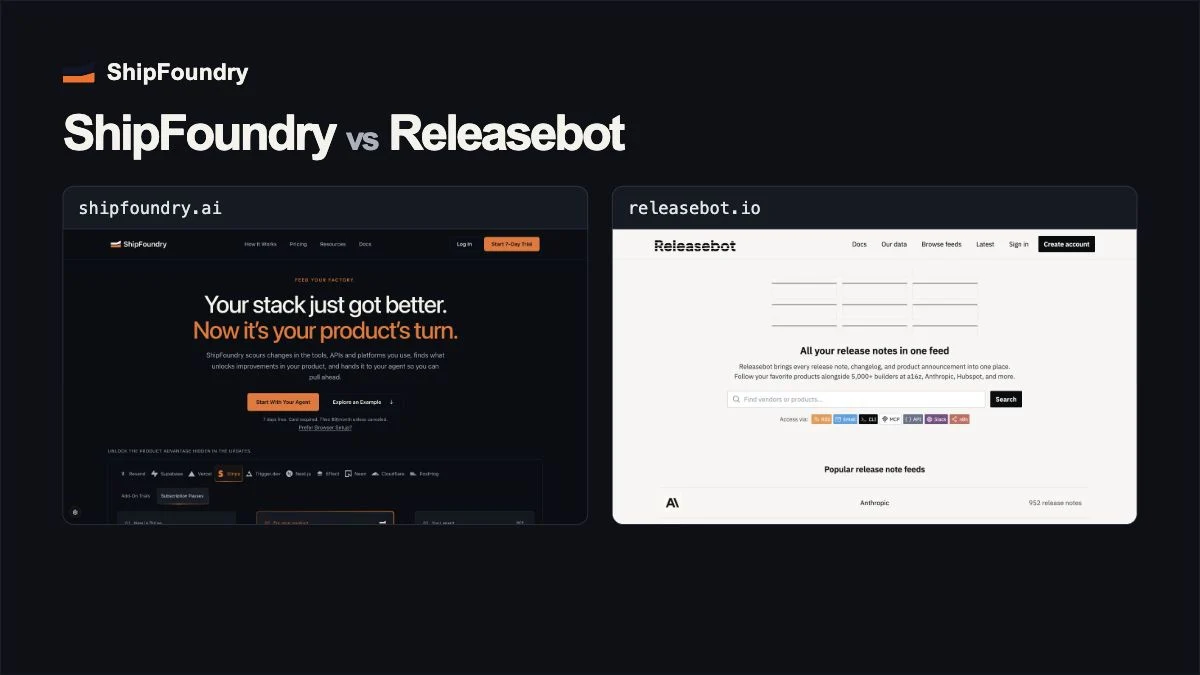
If you mainly want one place to follow software releases, Releasebot.io is the simpler choice. It collects vendor updates and exposes them through a feed, API, CLI and MCP server. If your coding agent already combines those releases with a good description of your product and consistently finds work worth doing, you may not need another service.
If the recurring problem is deciding which new capability could make your particular product better, evaluate ShipFoundry. It uses your goals, stack context and saved decisions to identify what a new capability could improve, then gives your existing agent a source-linked starting point to investigate. Both approaches can reach useful product changes. In both, you still own verification, implementation and deployment.
Scope: This comparison is written by ShipFoundry and is based on public vendor documentation checked November 9, 2026, not a hands-on side-by-side account test. It compares Releasebot.io, the release aggregator, rather than Releasebot.ai, a separate changelog-publishing product.
Capabilities at a glance
| Capability | Releasebot | ShipFoundry |
|---|---|---|
| Searchable catalog of release notes | ✓ Yes | ✗ No · Project discoveries |
| MCP, API and CLI | ✓ Yes | ✓ Yes |
| Match changes to product goals | Via your agent | ✓ Yes |
| Source-linked investigation brief | Via your agent | ✓ Yes |
| Built-in code implementation | ✗ No | ✗ No |
“Via your agent” means you supply the product context and run that step. ShipFoundry proposes opportunities from your tracked stack. Your agent still checks fit and implements approved changes. Releasebot documentation · ShipFoundry product overview
What are you trying to get from a new release?
Consider what happens when Supabase ships a new way to run local projects. There are three useful stopping points:
Know it shipped. You want the announcement, source and date without checking several vendor sites. A curated feed handles this job well.
Understand what it enables. You want to know what changed, which versions or conditions apply, and what the vendor actually documented. A capable agent can read the original source from Releasebot and perform this interpretation.
Choose work for this product. You want to know whether adopting that capability would improve your users' experience, your development workflow or your operating costs now. That decision depends on goals, the current setup, constraints and work already completed.
These are stages, not exclusive categories of tools. Releasebot plus an agent with the right project information can make the third decision too. ShipFoundry is useful only if its retained context and repeated selection of opportunities improve the process you already have.
Both support AI agents. Ask where your recurring friction sits: finding sources, evaluating changes against product goals, or getting a worthwhile improvement into your team's workflow.
How the two approaches divide the work
| Decision factor | Releasebot plus your agent | ShipFoundry plus your agent |
|---|---|---|
| Useful starting output | Curated releases, source links, a personal feed and search results. | Product-matched opportunity candidates, original sources and agent handoffs. |
| Product context supplied | Your agent uses the product context and decision history you make available. | A confirmed project profile, stack, goals, rules and saved answers shape matching. |
| Source coverage check | Verify the specific vendor, product and announcement; submitted sources are reviewed. | Verify the tool can be tracked and the relevant change was captured; coverage is not guaranteed. |
| Agent connection | Hosted or local MCP, API and CLI. | MCP, API, CLI and copied handoffs, with connected export options. |
| Repeated applicability decisions | You maintain the prompt, project facts and prior decisions in your own workflow. | Saved project facts, rules and answer branches can inform later selections. |
| Billing unit | Release-returning API, MCP and CLI calls use shared credits; Free and Pro limits differ. | Monthly project allowances and tracked-tool slots, not credits per returned release. |
| Implementation owner | Your agent or team inspects the code, implements and tests with your permission. | Your agent or team inspects the code, implements and tests with your permission. |
The distinction is in the responsibilities around the release. Releasebot's MCP tools include vendor searches, release lookup and a personal feed, and its API exposes source-linked results and date filters. Its CLI is another real option. Its API since and before filters use the date Releasebot discovered a release. The publisher's release date is a separate field, so a newly discovered item is not necessarily a newly announced capability.
ShipFoundry's product overview describes a different default workflow: confirm a product profile, choose stack items, evaluate changes against the product's goals and rules, then pass promising work to an agent. The project profile is persistent, but ShipFoundry does not continuously inspect your codebase to prove an opportunity applies. Your agent must do that. Agent workflows describe how that investigation and subsequent decisions remain in your own workflow.
Coverage matters on both sides. Releasebot curates submitted sources, so submitting a URL is not the same as immediate ingestion. ShipFoundry evaluates updates for selected tracked tools, but its project matching is not a promise that any particular announcement was collected. Before choosing based on one essential framework or API, check the named source and the specific recent release, not a marketing catalog count.
Your Releasebot workflow can retain goals, constraints and decisions in agent instructions or a persistent store; it need not rebuild them for every query. If you already maintain that context and a recurring prompt, Releasebot plus that setup can be enough. ShipFoundry's case is stronger when maintaining that process and making the applicability decisions repeatedly is the part you want a service to handle.
One Supabase change, two different product decisions
On October 14, 2026, Supabase announced multiple independent local projects, including one per Git worktree. The capability landed in Supabase CLI v2.119.0 behind an experimental setting. The local-projects guide, updated November 2, explains the prerequisites and limitations. The announcement is real; the products and outcomes below are illustrative.
| Product situation | Possible improvement | What must be checked | Reason to proceed or defer |
|---|---|---|---|
| Two agents use separate worktrees but interfere with one local database. | Give each worktree its own Supabase project for independent resets and tests. | CLI version, experimental setting, ports, runtime, migrations and test isolation. | Investigate if shared-state collisions are a real delivery bottleneck. |
| One active checkout, useful remote previews and an unrelated customer priority. | Probably no useful local-isolation change right now. | Whether parallel local testing is actually needed and what work it displaces. | Defer if it does not advance the current product goal. |
| Separate local projects are already working reliably. | No repeat implementation; keep the existing setup. | Adopted version, remaining limitations and whether anything is missing. | Dismiss this as already addressed, or investigate only a remaining gap. |
In the first case, two coding agents work on different features. One resets the local database while the other is testing. Independent projects could remove that coordination problem, but only after someone checks the existing configuration, fixed ports, supported runtime, migrations and whether tests actually collide. Supabase recommends Docker or Podman for several local projects on one computer; the native runtime fits supported isolated environments. The feature remains experimental, so this is a candidate for a controlled test, not a universal upgrade instruction.
In the second case, a team already has an effective single-checkout and remote-preview workflow. Its immediate goal is improving customer onboarding. Adding parallel local environments might be technically possible but offers no clear current product benefit. Defer is a legitimate outcome. If the first product has already adopted separate local stacks, already addressed is also useful: stop suggesting the same work without a new reason.
With the same source, a competent agent and an accurate product profile, either workflow could reach any of these decisions. The hypothesis worth testing is whether ShipFoundry reduces repeated context assembly and presents better-qualified opportunities over time. No time savings, customer result or product-specific output from either service was measured for these examples.
What your existing agent still needs
Before asking an agent to act on a release, supply five things: the product's current goal; the actual workflow that might improve; the stack and version state; important constraints; and whether the capability is already in use. Code may establish some of these. It cannot reliably infer which customer outcome matters most this month.
Here is a short, reusable relevance exercise. It works with a release found through Releasebot, ShipFoundry, or the vendor's own documentation:
We're building a small SaaS product using Supabase.
Goal: let two coding agents test features independently.
Current workflow: two Git worktrees can interfere through local database resets.
Constraints: avoid disruptive migrations; no production data in local tests.
Known state: confirm our Supabase CLI version, config and existing isolation.

Read Supabase's October 14, 2026 local-project announcement and
its current multiple-local-projects guide. Inspect our actual setup.

Is there one practical improvement worth trying now?
Return: proceed/defer/already-adopted; evidence; prerequisites;
a safe small test; risks; and what needs owner approval.
Do not change code or infrastructure yet.
This is a suggested prompt, not a transcript of an actual agent run. Notice that it asks for one justified improvement, not a generalized changelog summary or automatic implementation.
If your existing Releasebot-to-agent workflow reliably answers that question and your team acts on the good results, keep it. If every weekly review starts by rebuilding the same context, repeating exclusions and sorting candidates manually, test whether ShipFoundry's confirmed project context and saved decisions make that recurring job meaningfully easier.
Price the workflow you would actually use
As of November 9, 2026, Releasebot's published plans include a Free option and Pro at $5/month or $50/year. The API credit rules allocate 250 credits per 30-day period on Free and 5,000 on Pro; Max lists unlimited credits, but its price was not verified here. Release-returning API, MCP and CLI calls share a pool: one credit per returned release, with a minimum of one per request. Vendor search and follows listing do not consume credits. These are release retrieval units, not agent tokens or guaranteed useful ideas.
ShipFoundry's current public pricing lists Dev at $9/month for one project and 20 tracked tools, and Portfolio at $19/month for up to five projects and 60 shared tracked-tool slots. Following the same tool for two projects consumes two slots. These are project coverage allowances, not per-release API credits. There is no sound dollar-per-opportunity comparison without measuring your own review volume and outcomes.
Either approach may also use your existing agent's paid model or infrastructure resources. If you only need a short feed and a working prompt, the lower-cost option is compelling. If repeated selection across projects is where time disappears, compare the recurring quality of decisions rather than subscription prices alone. Check current terms at checkout before purchasing.
Choose Releasebot, choose ShipFoundry, or use both
Choose Releasebot if your main job is broad release awareness, source lookup or inexpensive programmable access. It is also a strong choice when you have already taught your agent your product goals and it consistently filters releases into decisions you trust. There is no reason to replace a successful workflow just to obtain another MCP connection.
Evaluate ShipFoundry if the hard part is a continuing stream of product-specific decisions: remembering which opportunities apply, excluding work that has already been done, retaining constraints and preparing a useful next investigation. The fit depends on support for the specific tools you track and the quality of the resulting suggestions. It is not a deep code audit, a release catalog for every vendor or an autonomous implementation service.
Use both if Releasebot is your broad reading and retrieval layer while ShipFoundry serves as a narrower work-selection layer for selected products. That is a choice about separate responsibilities, not a requirement to buy two overlapping feeds.
Change nothing if your existing vendor sources and agent review already lead to useful, implemented improvements. A second tool should earn its place through better decisions or less recurring setup, not through a longer feature checklist.
Questions that change the choice
Does Releasebot already have MCP?
Yes. Releasebot documents a hosted MCP server with OAuth or API-key access and a local npm server option. It can search vendors, retrieve releases and read your feed. ShipFoundry also has MCP, but MCP support alone is not a differentiator.
Could I give Releasebot's output to my coding agent?
Yes. Use its MCP tools, API, CLI, or copied source link. Give your agent your actual goals and constraints and require it to check the vendor source and local code before proposing implementation. The quality of this do-it-yourself workflow is the relevant baseline.
Does ShipFoundry need access to all my code?
No. You can supply and confirm product context manually or have your agent prepare it. Read-only GitHub import is optional. ShipFoundry doesn't search every repository file on each release; your existing agent inspects the code when it investigates an opportunity.
What if a provider does not cover a tool I use?
Check the exact vendor, product and announcement before depending on either workflow. Releasebot's sources are curated, while ShipFoundry's tracked-tool and update availability must be verified for your stack. If coverage is missing, use the vendor's original announcement with your agent rather than treating an absent result as proof that nothing changed.
Can I keep Releasebot?
Yes. You can keep its feed for discovery and use ShipFoundry only if the separate product-specific decision workflow proves useful. Or keep Releasebot alone and maintain your own recurring prompt and memory.
Who actually changes the code?
You and your agent, under the tools and permissions you control. ShipFoundry supplies candidate opportunities and handoffs, not a guaranteed fix or an automatically deployed pull request. Releasebot supplies source material that your agent can investigate in the same way.
Start with the product and goals you actually have. If you want to see which new stack capabilities could advance those goals, start with your agent in ShipFoundry, then judge the proposed improvement against your own code and priorities.