How to Turn Tech Stack Updates Into Product Improvements
Use a repeatable method to find new stack capabilities, connect them to your product goals and hand a scoped investigation to your coding agent.
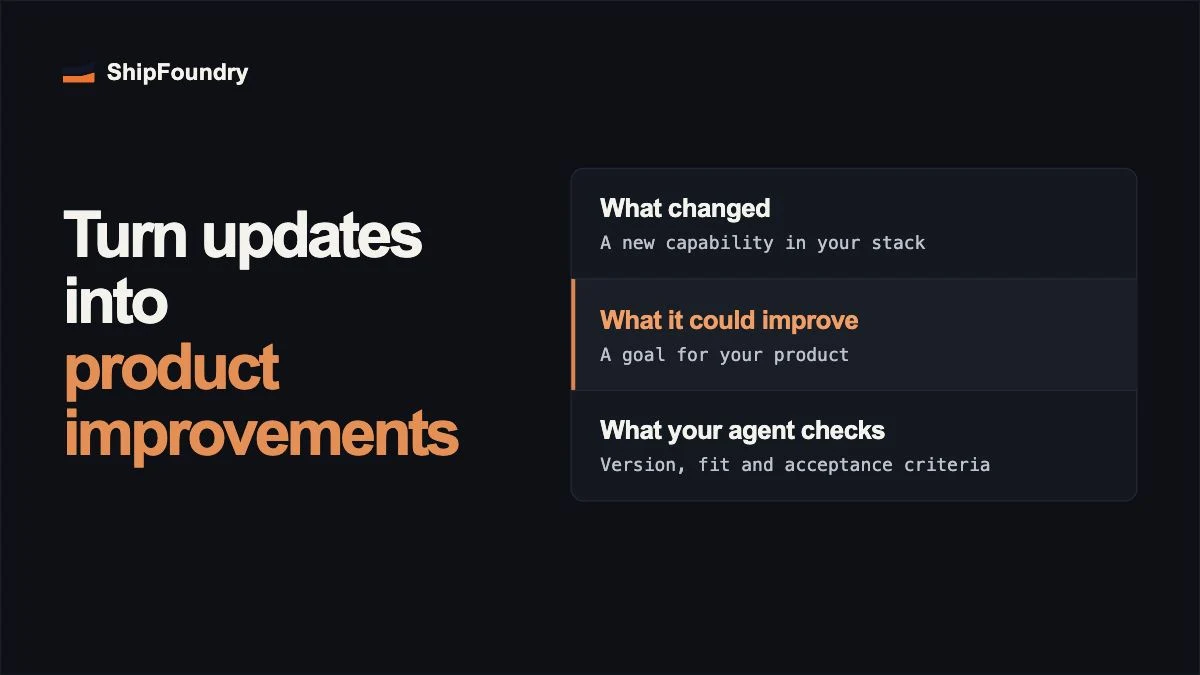
Turn tech stack updates into product improvements by connecting a documented capability to something useful your particular product could do. A new release may suggest a feature you had not considered, or help remove a limitation you already know about. Judge the opportunity against your users, goals, and constraints, have your existing coding agent investigate the smallest useful change, and measure the result. The outcome might be a better feature, lower cost, less maintenance, or a well-supported decision to do nothing.
For example, an asynchronous model API might make scheduled customer reports cheaper to produce. That is a candidate improvement, not a task to migrate every model call. You first need to know when customers expect their reports, whether the API supports your workload, and whether the savings survive retries and orchestration.
Scope: This guide is based on official vendor documentation and ShipFoundry's public documentation checked November 9, 2026. The application scenarios are illustrative. No ShipFoundry customer outcome, end-to-end product test, or before-and-after result is claimed.
1. Describe the product before judging the opportunity
A useful starting profile needs only five things:
- What the product does: Who uses it and what they are trying to accomplish.
- One objective: A customer or operating outcome that matters, including a new possibility suggested by the capability.
- Constraints: Deadlines, reliability, data-handling requirements, budget, or preferences.
- Relevant stack: The actual frameworks, hosted services, APIs, models, and agent tools in use, including versions where known.
- Current implementation: What the product already does, so the same change is not proposed twice.
Consider a hypothetical SaaS that summarizes documents inside customer workspaces. It already generates reports through a synchronous model API and a background job queue. Its objective is to reduce cost per accepted report while preserving the promised delivery time and summary quality. Its constraints include workspace isolation and an existing quality rubric. It uses a Claude model, but its exact model, request parameters, and customer deadline still need checking.
"Switch to a cheaper model" would be a proposed solution, not the objective. If batch processing, caching, or a better queue design reaches the objective with less risk, the goal should survive that change of plan.
Keep confirmed implementation facts and explicit preferences with the profile. "We already use this feature" and "We do not want this kind of change" are different facts. Both can save wasted investigation, but neither should be guessed from a dependency name.
2. Follow the sources that could advance the product
For a small product, start with authoritative updates from the services that determine its capabilities. Use current goals to focus attention, while leaving room for a relevant release to suggest a useful new workflow.
Package and framework release notes can reveal usable APIs or runtime changes. Hosted-service announcements can change what is possible without a package upgrade. Model documentation can alter the economics or quality of a task. Deployment-platform updates can remove configuration work. Agent-tool releases can change how an existing coding workflow is executed.
Keep security and required compatibility work on their own urgent path. This method is about optional product advances, not replacing necessary maintenance.
A few vendor pages and a saved note are enough if your stack is small. Broader coverage makes sense only when maintaining the source list and checking applicability repeatedly become meaningful work.
3. Turn the documented capability into a product consequence
Write two separate statements:
External fact: "On July 8, 2026, Resend announced that its email webhooks and retrieve/list endpoints expose message_id." That is supported by Resend's announcement.
Product hypothesis: "If our SaaS currently loses the connection between outgoing notices and inbound replies, this identifier might help associate a reply with its original conversation."
The second statement is not in the announcement. It depends on whether the product receives inbound mail, stores message identifiers, has the necessary reply headers, and actually needs a threaded workflow. A Message-ID alone does not create an inbox. The useful work starts with this distinction: what became possible versus what is worth changing here.
Product-improvement worksheet
Use one worksheet for one candidate. It should make the proposal intelligible to someone who never read the release note.
| Field | What to write | Why it changes the decision |
|---|---|---|
product_goal |
Problem to solve or useful new behavior to enable | Connects the capability to intended value |
external_change |
Dated announcement and source URL | Separates evidence from speculation |
proposed_improvement |
New behavior this could enable | States the product-level hypothesis |
beneficiary |
User or operator who benefits | Shows who would notice the change |
prerequisites |
Versions, access, configuration, constraints | Establishes whether it can apply |
unknowns |
Facts still requiring confirmation | Prevents assumptions becoming tasks |
smallest_change |
Minimal test or implementation slice | Limits risk and effort |
success_evidence |
Observable result and acceptance criteria | Defines what would count as better |
These are worksheet fields, not ShipFoundry product statuses or a scoring algorithm. If you cannot name a beneficiary and a measurable change, the release is probably information rather than a product opportunity.
4. Check applicability before assigning implementation
A release may exist while the improvement remains unusable. Check the installed package version and deployed version, not just the range in a manifest. For hosted APIs, check account access, enabled flags, region, plan, and relevant request modes. Inspect whether the behavior is already implemented, and whether the proposed change conflicts with product rules or customer expectations.
Ask the owner for preferences and account-level facts that code cannot prove. Let the agent inspect authorized local code, job configuration, tests, and manifests. If a decisive fact is unknown, write it as a question with its consequence: "If reports must arrive within ten minutes, would asynchronous batches still meet the promise?" Do not silently answer yes.
ShipFoundry's product overview describes a similar boundary: it selects potential improvements against confirmed project context and can ask a short factual question. The customer's agent still checks actual repository applicability. ShipFoundry does not continually inspect the repository to prove each recommendation correct.
What should happen to this opportunity?
| Finding | Sensible next step | Evidence to keep | Revisit trigger |
|---|---|---|---|
| Plausible and useful, but uncertain | Investigate a bounded slice before approving code changes | Source, unknowns, acceptance test | Applicability confirmed and sample test passes |
| Already adopted | Record the existing behavior; skip duplicate work | Deployed version, code path, observed behavior | Regression or a genuinely new capability |
| Not applicable to this product | Ignore with a specific reason | Mismatch with goal, stack, or rule | Product objective or relevant stack changes |
| Useful but blocked | Defer until the missing prerequisite is met | Required version, access, or dependency | Required version deployed or access granted |
| Provider improvement already automatic | Observe if material; create no implementation task | Vendor notice and relevant telemetry | Regression or provider behavior changes |
An "investigate" decision is not authorization to deploy. An "ignore" decision may be correct even for an impressive release. These are editorial choices for managing work, not names of native ShipFoundry outcome states.
5. Worked example: make scheduled summaries less expensive
Return to the hypothetical workspace-summary SaaS. Its limitation is high recurring cost for reports that are not interactive. Its beneficiary is the operator, with customers benefiting only if quality and delivery expectations remain intact.
The external change to assess is Anthropic's Message Batches API. The current documentation describes asynchronous processing, per-request results, and batch pricing at 50% of standard API token rates for eligible usage. It also says processing can take up to 24 hours and individual requests may fail or expire. Results can be downloaded for 29 days after the batch is created. This does not establish a 50% reduction in the SaaS's total report cost.
The proposed improvement is to send eligible nonurgent reports through a batch path while keeping time-sensitive work on its existing path. Its prerequisites are a compatible model and request configuration, a delivery promise that tolerates the wait, an authorized data-handling policy, and a job system that can reconcile results.
Its unknowns are concrete: What deadline do customers actually expect? Which model and features are used? How many requests fail or expire? How do results return to the correct workspace? How will retries prevent duplicate report delivery and account for any extra processing cost? Does the current queue already offer a better solution? Anthropic's documentation also says batch processing is not eligible for zero data retention or HIPAA, a potentially decisive blocker for some products.
The smallest change is a controlled experiment on a representative, authorized set of reports. Keep the same model, input documents, prompts, evaluation rubric, and delivery requirements for a synchronous baseline and batch candidate. Build only enough orchestration to submit, retrieve, correlate, retry safely, and audit results. Do not migrate production workloads before review.
For success evidence, record accepted report counts, quality checks, completion times, expired and failed requests, retries, billed tokens, and recurring queue and storage costs. Compare both paths over the same workload and period. Track one-time implementation effort separately so it can be weighed against recurring savings. Compare:
Cost per accepted, on-time report = total processing and orchestration cost / number of reports meeting quality and delivery requirements.
If quality declines, data policy excludes batches, or too many reports miss the deadline, the idea may be rejected despite the API discount. No costs, timings, quality scores, or savings in this example were measured.
6. Two other outcomes, and one update that needs no task
New feature: Resend's July 2026 Message-ID release could support a reply-linked conversation flow in a product that lacks one. First inspect inbound-message handling, headers, persistence, and user demand. The opportunity is a user workflow, not the act of saving another header.
Less configuration work: Vercel's November 2, 2026 announcement describes Project Connections for reading flags across projects in the same team without manually sharing SDK keys. Its setup documentation specifies supported SDK versions, deployment identity, and broad read access to source-project flags. A multi-project product that currently copies keys may have a simplification opportunity. A single-project app, an incompatible SDK, or a team that needs narrower access may not. The benefit would be removing actual configuration work, not gaining a feature merely because an announcement exists.
No implementation needed: On October 27, 2026, Vercel said its own Agent sessions had become more efficient and that the improvement was already live. That is a provider-reported change to a specific service, not a demonstrated saving in your product. If you use it, you might observe relevant costs; there is no reason to invent a migration task to receive an already-active benefit.
7. Give your coding agent a bounded investigation
A competent agent can do most of this work if you supply the source, product context, and authority boundaries. Save this prompt and replace the bracketed text:
Investigate a possible improvement to [product]. Do not change code yet.

Product goal: [observable customer or operating outcome]
Current behavior: [what happens today and the useful change to investigate]
External source and announcement date: [URL and date]
Proposed benefit: [the smallest plausible product consequence]
Relevant scope: [service, package, versions, feature, code area]
Constraints: [deadline, data rules, quality, reliability, budget]
Known facts: [verified implementation and account facts]
Unknowns: [questions to verify; do not assume answers]

Read the source and inspect only authorized local evidence.
Check whether the capability applies, is already adopted, or is blocked.
If useful, propose the smallest reversible experiment, test plan, observable
success criteria, and decisions or permissions outside the granted scope. Also explain
why we might reject it. Do not implement, deploy, or change external
services without separate authorization. Report evidence and uncertainty.
An agent may discover that the feature is already in use or that the improvement is unsuitable. That is a useful investigation result. If implementation is approved, the agent follows the team's normal code review, testing, rollout, and deployment process. Its ability to write code does not validate the original business hypothesis.
8. Close the loop on product value
After investigation or implementation, preserve the source, decision, verified project facts, changes made, tests, and result. Then compare the new behavior with the intended improvement.
Could the user complete a workflow that previously failed? Did a recurring manual step actually disappear? Did cost per successful batch fall while quality and deadlines stayed acceptable? A merged pull request, copied handoff, or closed issue is evidence of activity, not by itself evidence of product value.
Record rejections too, including their decisive reason and the event that would make a revisit sensible. That prevents next month's review from proposing the same unsuitable work as if nobody had checked it.
9. Pick the lightest system that keeps producing useful decisions
A few vendor sources plus a worksheet: Best for one small product with a limited stack and an owner who can review changes. It is transparent, inexpensive, and easy to stop. Keep it if it already surfaces worthwhile work.
Your existing coding agent or scheduled automation: Best when you can supply maintained product context, authoritative sources, permission boundaries, and a durable outcome log. A competent custom agent can make the same reasoned connections. You own source coverage, scheduling, context drift, and verification of its output.
ShipFoundry alongside your agent: Worth considering when repeated matching across the tools you actually use becomes a chore. It uses confirmed goals, constraints, stack context, explicit rules, and saved answers to select possible product improvements and provide source-linked handoffs. You can use a copyable handoff or MCP, API, and CLI workflows. You still supply the agent and control investigation, permissions, implementation, and deployment. ShipFoundry does not guarantee a useful opportunity on every review or verify code-level applicability on its own.
Choose according to the work you need help maintaining: source coverage, product context, candidate selection, and follow-through.
Frequently asked questions
How much of my stack should I follow?
Start with the dependencies and hosted services that could change your current product goal. Include framework, model, API, and infrastructure sources where they affect the user experience or operating constraint. Add broader monitoring only when the missing opportunities justify its maintenance cost.
What if I already read the changelogs?
Keep reading them if it works. Add a short note beside a promising change: whose problem it addresses, what must be true, what your agent should inspect, and what result would count. You do not need another feed to make that decision.
Can I do this with my current coding agent?
Yes. Give it dated primary sources, accurate product context, and an investigation prompt like the one above. Require it to distinguish observed code from assumptions and record the outcome. If you automate reviews, maintain the source list, context, and permission limits yourself.
What if the feature is already implemented?
Record where it is implemented and, ideally, verify deployed behavior. Do not create duplicate work. Revisit only if a new release adds something beyond the existing implementation or the behavior regresses.
How do I decide whether an improvement was worth it?
Check the intended improvement after the change. For a feature, check whether users can complete the intended workflow. For cost, count successful outputs at acceptable quality and latency, not just a lower unit price. For simplification, confirm that the manual work or configuration really disappeared. Keep a rejected experiment as a valid result.
To assess a capability against your own stack, find opportunities for your product. Bring your product context and goals, review the proposed improvement, and investigate a relevant lead with your existing agent.