A weekly workflow for improving your product with a coding agent
Run a weekly review that turns relevant stack changes into a scoped coding-agent task, with evidence, explicit permissions and a clear next step.
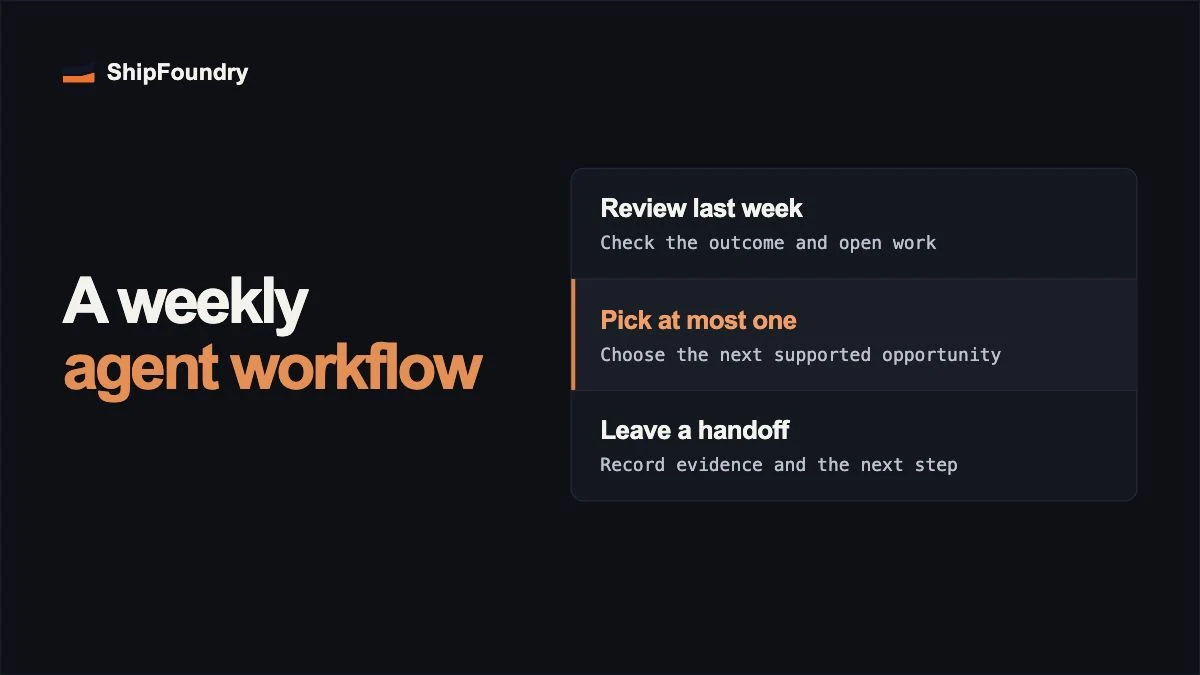
A useful weekly product-improvement cycle leaves a clear record: a verified change, a specific next step for valuable unfinished work, or an evidence-backed decision not to proceed. Record what changed and what was checked so the next session can continue from the actual result.
Start from one current product goal. Revisit the last outcome, compare a few sourced opportunities, let your existing coding agent investigate one, implement a coherent change only when it is justified and authorized, verify the behavior, and save what you learned. A weekly review is a practical starting rhythm, not a promise to ship something every Friday.
Scope: This is a documentation-based workflow guide, with sources checked November 9, 2026. The export example below is illustrative. No customer implementation or comparative agent test was performed.
The recurring improvement cycle
| Stage | Input | Useful output | Done when |
|---|---|---|---|
| Previous outcome | Last decision and checks | Continue, close, or revisit the work | Result checked or blocker carried forward |
| Selection | Current goal and sourced candidates | One candidate, or none, with a reason | Duplicates and existing capabilities ruled out |
| Investigation | Source, context, relevant code | Applicability finding and open questions | Path forward or reason not to act is evidenced |
| Implementation | Authorized scope and acceptance criteria | Coherent change or bounded continuation plan | Change finished or remaining work and blockers named |
| Verification | Changed behavior and test access | Observed result, not only green checks | User outcome demonstrated or marked unverified |
| Continuation | Decision, changes, checks, remaining gaps | Durable outcome record and next trigger | Next cycle can resume without rediscovery |
The work-in-progress default is one active product improvement. Finish verification on last week's change before opening another, unless a customer need or operational incident takes priority. The cadence can be slower for stable products, and a genuinely time-sensitive capability need not wait for the weekly review.
Keep a standing brief that fits on one screen
Give the agent a concise product brief and access to the relevant evidence. The standing brief should name the product and its users, one observable current objective, constraints that matter, relevant frameworks and hosted services, capabilities already adopted, and the location of the last outcome record.
For example, “customers can finish a large export without support intervention” is a useful objective. “Use the latest workflow platform” is not. Refresh the objective, deployed behavior, versions or service configuration, and any new customer evidence each cycle. A source change can be real and still have no bearing on the product's current need.
Review the last outcome before looking for the next idea
Read the prior record first. Was the proposed user behavior actually demonstrated? Is a deployment, acceptance check, or post-release observation still outstanding? Did a previously blocked prerequisite change?
If last week's implementation is unfinished or unverified, the most valuable next task may be to complete that work. A recorded decision to defer is also a legitimate outcome, provided its revisit condition is explicit. If urgent roadmap work is already more important than any new external capability, do that instead.
Select from a bounded set of sourced opportunities
Bring a small candidate set, perhaps two to five updates or concrete feature possibilities. Each candidate needs a primary source and a one-sentence explanation of which product behavior it could improve. The source might be official release notes or platform documentation; it need not have been published that week if the capability has only just become relevant to the product.
Remove duplicates, previously adopted capabilities, and ideas that contradict known constraints. Then apply this table. These are operating decisions for your team, not ShipFoundry status names.
Decide what happens to each opportunity
| Finding | This cycle's action | What to remember |
|---|---|---|
| Relevant and untested | Inspect one candidate against the product | Source, goal, and applicability question |
| Already adopted | Do not open duplicate work | Evidence of the existing behavior |
| Not useful for this goal | Reject with a short reason | Constraint or product mismatch |
| Potential value, missing prerequisite | Get the specific answer or permission | Blocker, owner, and unblocking trigger |
| Useful later, not now | Defer without an active task | Reason and explicit revisit trigger |
| No worthwhile candidate | Return to higher-priority product work | Checked sources and why nothing qualified |
Choose one relevant candidate to investigate. If it needs a prerequisite answer, resolve that question before expanding the work. When nothing qualifies, return to the product's existing priorities.
Investigate applicability in the real product
For the one selected candidate, give the agent the original source, the expected customer benefit, the standing brief, known assumptions, and a narrow question. Then let it inspect the relevant repository files, configuration, logs, or tests within the access you actually granted.
Ask for three distinct kinds of evidence: what the vendor documents, what the agent observed in this product, and what remains unknown. An update can describe a genuinely useful capability while the app already has it, depends on an incompatible component, or lacks an important prerequisite. If the missing fact changes the decision, return that precise question rather than guessing.
End the investigation with a specific decision: adopt a suitable path, improve an existing implementation, run a contained experiment, defer, or stop.
Implement the smallest complete user outcome
Define one behavior and its acceptance evidence before changing code. For an export flow, the smallest useful slice might let a customer request an export, see whether it is running or finished, and retrieve the output without asking an operator to intervene. A cosmetic status label without a reliable job behind it would be too small.
Use the coding agent and normal review process you already trust. Within the authority provided, it may change code, configuration, tests, or documentation. If implementation or deployment is outside that authority, it should produce a bounded plan identifying the exact files, checks, decisions, and permissions needed, and label the work incomplete. An investigation brief is not authorization to deploy.
Verify the behavior, then leave a continuation record
Match the checks to the promised benefit. A passing typecheck can support confidence in the code; it cannot demonstrate that a user can finish an export. For a workflow change, exercise the complete user path. For a cost improvement, compare the same representative workload at an acceptable quality threshold. For removed manual work, show which intervention the user no longer needs.
If tests pass but the user behavior has not been exercised, record implemented, not yet verified. If the agent only investigated, record that, too. The record should survive a fresh agent session and be small enough to read next week.
Keep a usable outcome record
The following are example record entries, not claims about a real product or a completed test.
| Record field | Example of useful evidence | Why the next cycle needs it |
|---|---|---|
| Source and date | Official capability page, date checked | Detects when the premise might change |
| Product goal | Users retrieve large exports unaided | Keeps work tied to the customer need |
| Applicability | Runner configuration checked, or not yet checked | Avoids repeating or fabricating discovery |
| Decision | Investigate queue before migration | Preserves the reason for the choice |
| Implementation result | PR and changed paths, or not implemented | Separates a plan from a change |
| Verification | Fixture result and user retrieval, or not run | Separates passing tests from product benefit |
| Next trigger | Revisit on a reproducible retry failure | Tells the next session when to resume |
Store the record wherever the team actually resumes work: a repository note, issue, project document, or a supported outcome field. Link to commits and test receipts when they exist. Update standing context deliberately when a fact is confirmed; do not assume an agent or a recommendation service learns from every click, PR, or passing test.
Copy this brief into your coding agent
Replace the bracketed fields and paste it into the agent you already use. It does not require a particular vendor integration or unverified tool command.
Run one product-improvement cycle. Do not invent evidence or expand permissions.

Product: [What it does, and for whom]
Current objective: [One customer-visible or measurable outcome]
Constraints: [Security, budget, architecture, deployment, or product limits]
Relevant context: [Stack, current behavior, adopted capabilities, recent decisions]
Previous outcome record: [Link, file path, or pasted last result]
Candidate opportunities: [Primary source URLs + proposed product benefit for each]
Scope and authority: [What you may inspect, change, test, commit, or deploy]
Available effort: [Chosen budget or stop condition]

1. Read the previous outcome first. Continue valuable unfinished verification
   or blocked work if its prerequisite changed.
2. Check each candidate against the current goal, source, existing code,
   and constraints. Choose at most one, or none. Explain why.
3. For the selected candidate, inspect only relevant files and configuration.
   Separate documented facts, observations, and unknowns. If the capability
   is already adopted or unsuitable, record that and do not duplicate work.
4. If a missing fact blocks the decision, state the exact question, why it
   matters, and what evidence or owner action would resolve it.
5. If justified and authorized, make the smallest complete change serving
   the objective and run focused checks. Otherwise, leave a bounded plan
   explicitly marked incomplete. Do not deploy outside the given authority.
6. Report: proposed benefit; disposition and reasoning; source evidence;
   actual changes and links; checks with results; remaining limitations;
   user-behavior verification; and the next trigger or action.
7. Update the previous outcome record only within the allowed scope.
   Distinguish implemented-and-verified, implemented-not-verified,
   investigated-only, already-adopted, deferred, rejected, and blocked.
The scope and authority field is deliberately specific: a read-only agent session, an agent allowed to open a PR, and one allowed to deploy are different arrangements. Available effort limits the session; it is not an estimate that the change will fit. If no candidate qualifies, the correct output is a short negative decision and a return to higher-priority product work.
Worked cycle: making large exports reliable
Illustrative scenario only. No ShipFoundry customer, codebase, agent run, or measured result is represented here.
Imagine a small SaaS where customers request large data exports. Some incomplete exports have required an operator to restart the job. The current objective is for customers to initiate an export, understand its status, and retrieve a completed file without intervention.
Previous outcome: The standing record says the export path still needs an interruption-recovery check. That unfinished check comes first. The agent should not declare the workflow ready based on the existence of a background task alone.
Candidate and source: Vercel Workflows documents durable multi-step execution that can retry failed steps and resume across crashes or deployments. This is an existing capability newly relevant to the hypothetical export problem, not a claim that Vercel launched it this week. It is one possible route. Improving the SaaS's existing queue might be the better route, especially if the job is a single retryable task.
Investigation: Ask the agent to trace where export jobs start, where progress and completion are persisted, how the UI discovers status, and whether retry or duplicate execution can create inconsistent files or records. It should inspect the current worker and queue configuration, then compare the least disruptive repair against a workflow migration. Design retry-safe side effects as part of that investigation. The Workflow SDK's idempotency guide explains how a lost response can cause an external operation to be repeated and how stable idempotency keys can prevent duplication where the receiving API supports them. Also check how duplicate export requests are handled.
Smallest complete slice: If the current runner lacks needed recovery behavior and a workflow change is justified, propose a persisted export state, interruption-safe processing, a status view, and a retrievable artifact for one supported export type. If the existing runner already handles recovery, keep it and fix only the missing status, retrieval, or test coverage. The choice follows the investigation, not the product name in the source link.
Verification plan: Run one representative export in a controlled fixture; interrupt processing at a defined point; resume or retry it; check that stored status reflects the real result; and confirm the requesting user can retrieve the correct file. Test the effect of a duplicate attempt rather than assuming exactly-once behavior. Also run the usual focused regression checks. These are proposed tests, not tests that were executed for this article.
Possible record: “Decision: inspect existing runner before migration. Implementation: not yet performed. Verification: controlled interruption and retrieval tests not run. Next: perform authorized inspection and choose the simpler valid path.” A cycle that eventually rejects the Vercel migration because the existing runner already solves the problem can still be successful: it avoided unnecessary change and preserved the evidence.
Choose the operating arrangement you actually need
Start manually when you have not established that your candidate sources and brief lead to valuable work. A recurring calendar reminder and the prompt above are enough to test the habit. A manual run also makes it easier to notice vague goals and low-quality inputs before automating them.
Use your existing agent's scheduler when source selection, permissions, and verification are already reliable. Cursor Automations documents scheduled and event-triggered cloud agents with configurable tools and repositories, billed according to cloud-agent usage. Claude Code cloud scheduled tasks, previously called routines, support cloud runs on schedules and other triggers; the documentation labels them a research preview. Their host and permission models are not identical. You still own the scope, review, and deployment decisions.
Use an execution-focused workflow when completing longer coding shifts is the main need. For example, Nightshift's product-evolution workflow describes researching a product, ranking evidence-backed opportunities, and building bounded improvements in Claude Code, Codex, or Cursor, with a review boundary. That is a meaningful alternative, and it can complement product-specific change discovery. This article does not compare their success rates; none were tested here.
Add ShipFoundry when candidate selection is the recurring gap. ShipFoundry connects external stack capabilities to a particular project's goals and context, supplies potential improvements and handoffs, and lets the customer continue through an existing agent. Its agent-workflow documentation covers reviewing recommendations, using MCP/API/CLI, and recording outcomes; agent setup describes the connection options. ShipFoundry does not run the customer's coding agent, schedule its sessions, or establish code-level applicability before that agent investigates. If you already select strong opportunities with release feeds and a saved prompt, keep the simpler setup until it becomes a real bottleneck.
Practical questions
What if there is no worthwhile improvement this week?
Choose none, record which sources and goals you checked, and spend the time on the roadmap or existing customer requests. Do not manufacture a task to satisfy the calendar.
Can I use the coding agent I already have?
Yes. This workflow needs an agent that can inspect the relevant project within your permissions and return evidence. You do not need to change hosts just to use the prompt. Connect a discovery service only if its candidate selection helps.
Do I need to automate the schedule?
No. Start with a manual review; automate when you trust the inputs and have defined who can approve changes and what the agent may do unattended. A weekly rhythm is an editorial default, not a ShipFoundry scheduling feature.
What if the agent finds that the opportunity is already implemented?
Record the files, configuration, or test that establish it. Close the candidate as already adopted, and do not open duplicate work. If the user experience is still poor, investigate that separate problem on its merits.
How do I stop this from becoming another backlog?
Limit active work, revisit unfinished verification first, and require every deferred idea to have a reason and a trigger. A copied handoff or new ticket is not evidence of a product improvement.
Who implements and deploys the change?
Your chosen coding agent and team operate within the tools and permissions you provide. ShipFoundry can supply the opportunity and handoff, but it does not automatically implement, merge, or deploy it. Record whether the improvement was merely proposed, implemented, tested, or observed in the user-facing environment.
If you want help finding a candidate that fits your own stack and product goal, find the next useful improvement. Bring your product context, review the proposed opportunity, and carry the investigation into the coding agent you already use.