Signals
Langfuse v4 Makes Every Agent Step Directly Queryable
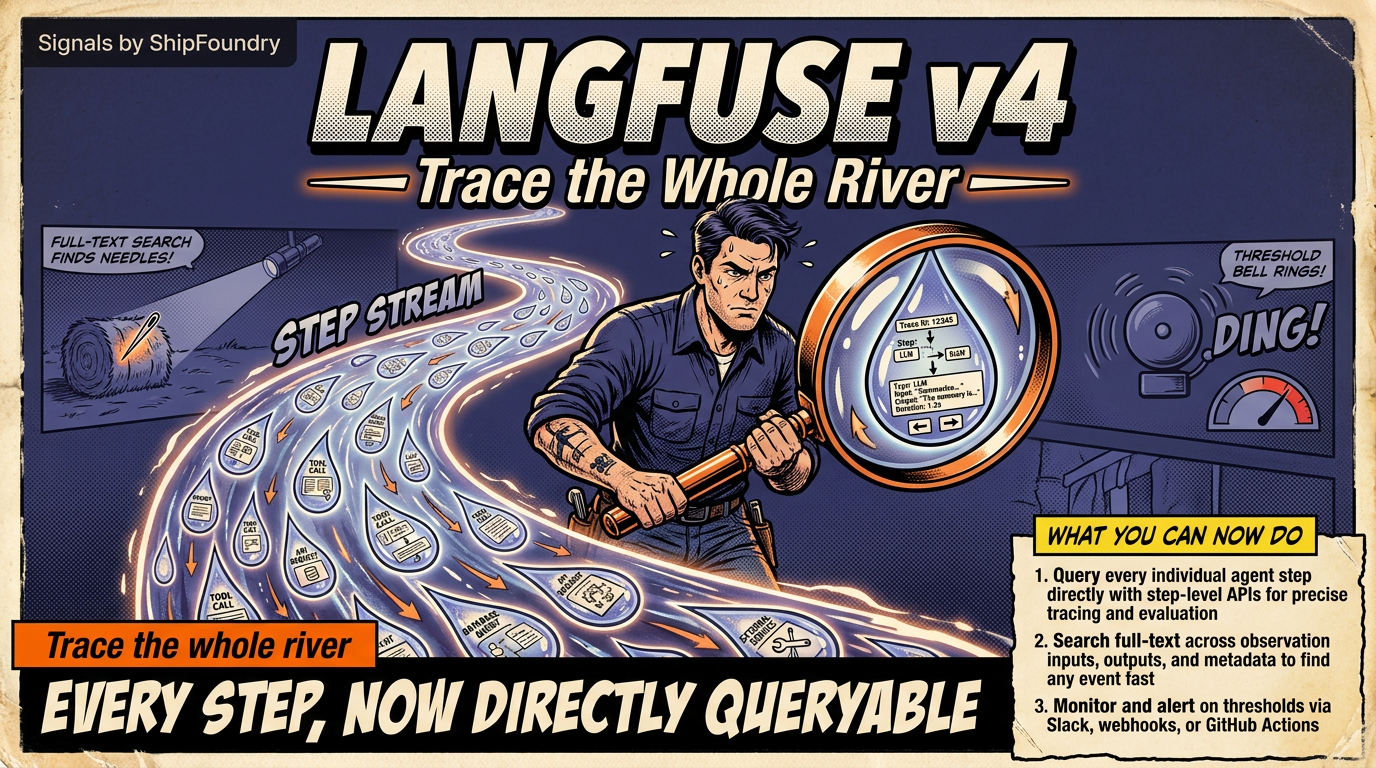
Langfuse v4 moves trace-level attributes onto each observation before ingestion and stores completed observations in one immutable, append-only table. That removes the read-time joins and deduplication Langfuse used in v3. Langfuse reports initial table loads over large datasets dropping from seconds to milliseconds and long-range dashboards loading at least 10x faster on large projects. v4 also adds step-level querying, search, monitors, code evaluators, and new APIs. Langfuse Cloud becomes v4-only on November 16, 2026.
What Changed
- Storage model: one denormalized observations table replaces read-time joins between traces and observations; each completed observation is written once in an immutable, append-only table.
- Observations API v2: retrieve selected observation fields with cursor-based pagination.
- Metrics API v2: aggregate cost, tokens, volume, latency, and scores across observations.
- Full-text search across observation inputs, outputs, and metadata.
- Pulse: plot count, cost, or latency above the Observations table and select a spike to inspect its operations.
- Monitors: threshold alerts on cost, quality, or latency, with Slack, webhook, or GitHub Actions targets.
- Code evaluators: Python or TypeScript functions that run deterministic checks on live observations and experiments.
- SDK requirements: Python 4.7.0+ and JS/TS 5.4.0+ add trace-level attributes such as user_id and session_id to every observation before ingestion.
Who Should Care
- Langfuse Cloud teams with large projects where long-range dashboards or trace queries are already slow. The new storage model is designed specifically to reduce that read-time work.
- Self-hosted teams on v3 that are feeling query-time join and deduplication costs at scale. v4 is generally available, but self-hosters can plan the upgrade on their own schedule and should review the infrastructure requirements first.
- Engineers debugging complex agent flows who want to inspect and evaluate individual LLM calls, tool executions, or agent steps without treating the whole trace as the unit of work.
Who Should Not Care
- Teams with modest trace volume and no real dashboard or query-performance pain. The architecture is cleaner, but the reported speedups are concentrated in large projects and long-range queries.
- Teams that do not need step-level APIs, monitors, code evaluators, or the new search surfaces yet. There is useful new tooling here, but that does not make every project urgent.
- Self-hosters who do not want to upgrade infrastructure right now. There is no forced self-hosted cutover date, and Langfuse says v3 will receive security patches through January 2027.
The Verdict
Langfuse v4 is a meaningful architecture and tooling upgrade, especially for large observability projects. The single-table model makes individual agent steps much easier to query and evaluate, and Langfuse reports initial table loads in milliseconds plus at least 10x faster long-range dashboards on large projects. Those are Langfuse's benchmarks, not a universal guarantee. Cloud teams have a November 16, 2026 cutover; most projects need no migration, while flagged projects need to complete their Migration Assistant actions. Self-hosters can move on their own schedule. If you already have query pain at scale or want the new step-level APIs and evaluation surfaces, it is worth investigating now. If not, it can wait.
Take This To Your Agent
Copy a ready-to-paste investigation handoff that asks your coding agent to check this update against your product and recommend what to do next.