Signals
Kimi K3 Makes Frontier-Class Agent Intelligence Open-Weight
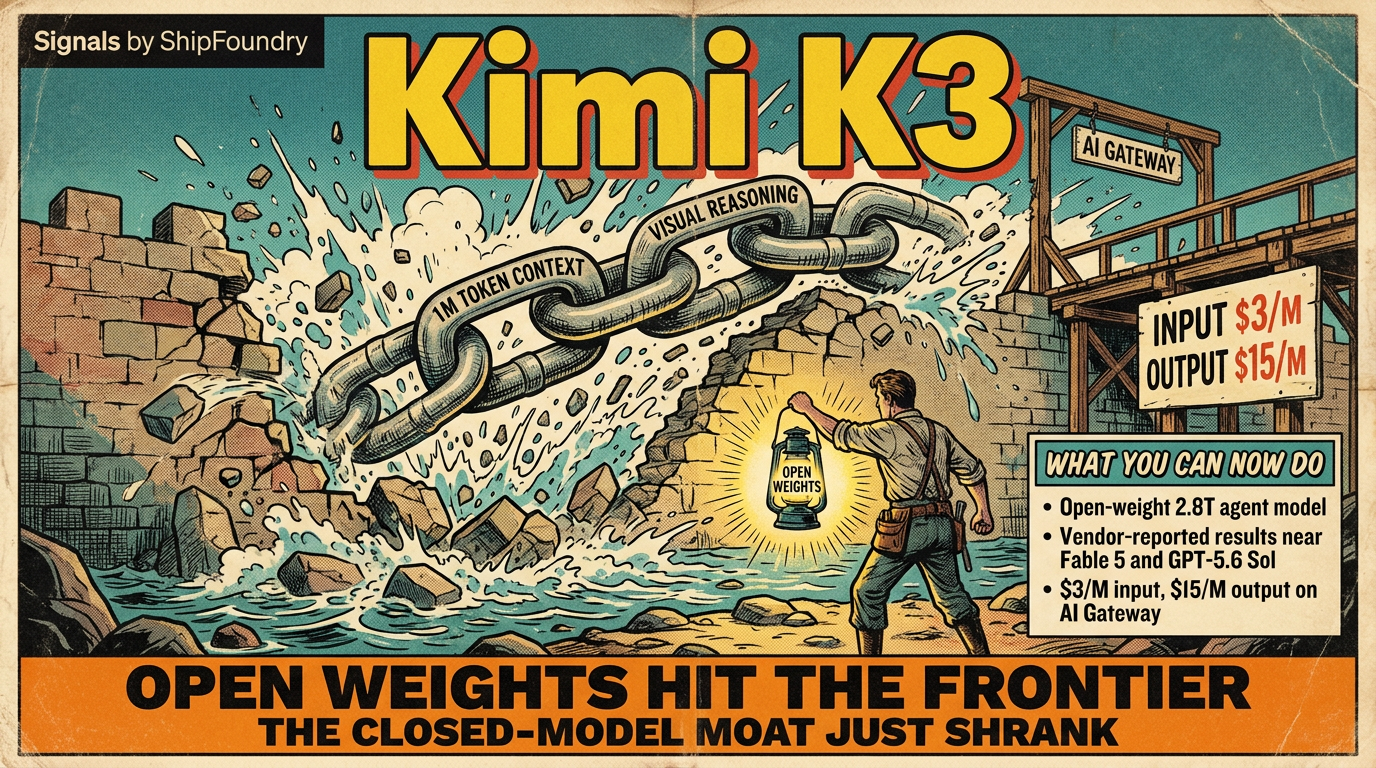
Moonshot released Kimi K3 as a 2.8T open-weight model for long-horizon coding, tool use, and knowledge work. Moonshot's own evaluations put it near Fable 5 and GPT-5.6 Sol on several agent benchmarks, while Vercel AI Gateway serves it for $3 per million input tokens and $15 per million output tokens.
What Changed
- Kimi K3 is a 2.8T mixture-of-experts model with 104B active parameters, native text and image input, a 1M-token context window, and thinking enabled by default.
- Moonshot released the complete model weights under the Kimi K3 License, giving teams a deployment and customization path that closed frontier models do not offer.
- Moonshot reports Kimi K3 at 88.3 on Terminal-Bench 2.1, 77.8 on ProgramBench, and 94.5 on MCPMark Verified, close to or above Fable 5 and GPT-5.6 Sol on those specific evaluations.
- Vercel AI Gateway lists Kimi K3 at $3 per million input tokens, $15 per million output tokens, and $0.30 per million cache-read tokens across Moonshot and several third-party providers.
- That is 70% below Fable 5's $10 input and $50 output list price per million tokens. It does not prove a 70% lower cost per successful task, which depends on quality, token use, latency, and retries.
- US-based providers on AI Gateway add optional Zero Data Retention, US inference routing, automatic failover, and a faster serving tier.
- The benchmark table is Moonshot-reported and mixes harnesses across models. The weights are open, but the Kimi K3 License includes commercial conditions for very large products and model-as-a-service businesses.
Who Should Care
- Agent builders comparing Fable 5, GPT-5.6 Sol, and other premium models for coding, tool use, or long-horizon work.
- Teams whose model volume makes a $3 input and $15 output API route materially different from premium closed-model pricing.
- Products that want an open-weight deployment option without giving up access to managed US inference, failover, and Zero Data Retention.
- Builders already using OpenAI- or Anthropic-compatible clients who can run a bounded Kimi K3 evaluation without rebuilding their model layer.
Who Should Not Care
- Small workloads where premium-model spend is negligible and another provider route would add more complexity than value.
- Teams that require independently reproduced benchmarks, mature enterprise support, or a simple unrestricted open-source license before evaluation.
- Workloads that cannot use Moonshot, third-party Kimi providers, or self-hosted infrastructure because of privacy, residency, procurement, or policy constraints.
- Products without a real coding, multimodal, knowledge-work, or long-horizon agent workload to benchmark.
The Verdict
This is one of July's structural Signals, not another model-release headline. A model competing in the Fable 5 and GPT-5.6 Sol performance tier is now available as weights and through production APIs at $3 input and $15 output per million tokens. That shrinks both the capability gap and the closed-provider pricing moat. The benchmarks remain vendor-reported, so evaluate cost per successful task, hosting requirements, provider boundaries, and license fit before adopting it.
Included In
July 2026 Signals: 8 Stack Changes Worth Your AttentionTake This To Your Agent
Copy a ready-to-paste investigation handoff that asks your coding agent to check this update against your product and recommend what to do next.