Signals
MCP Removes Protocol Sessions and Changes How Clients Connect
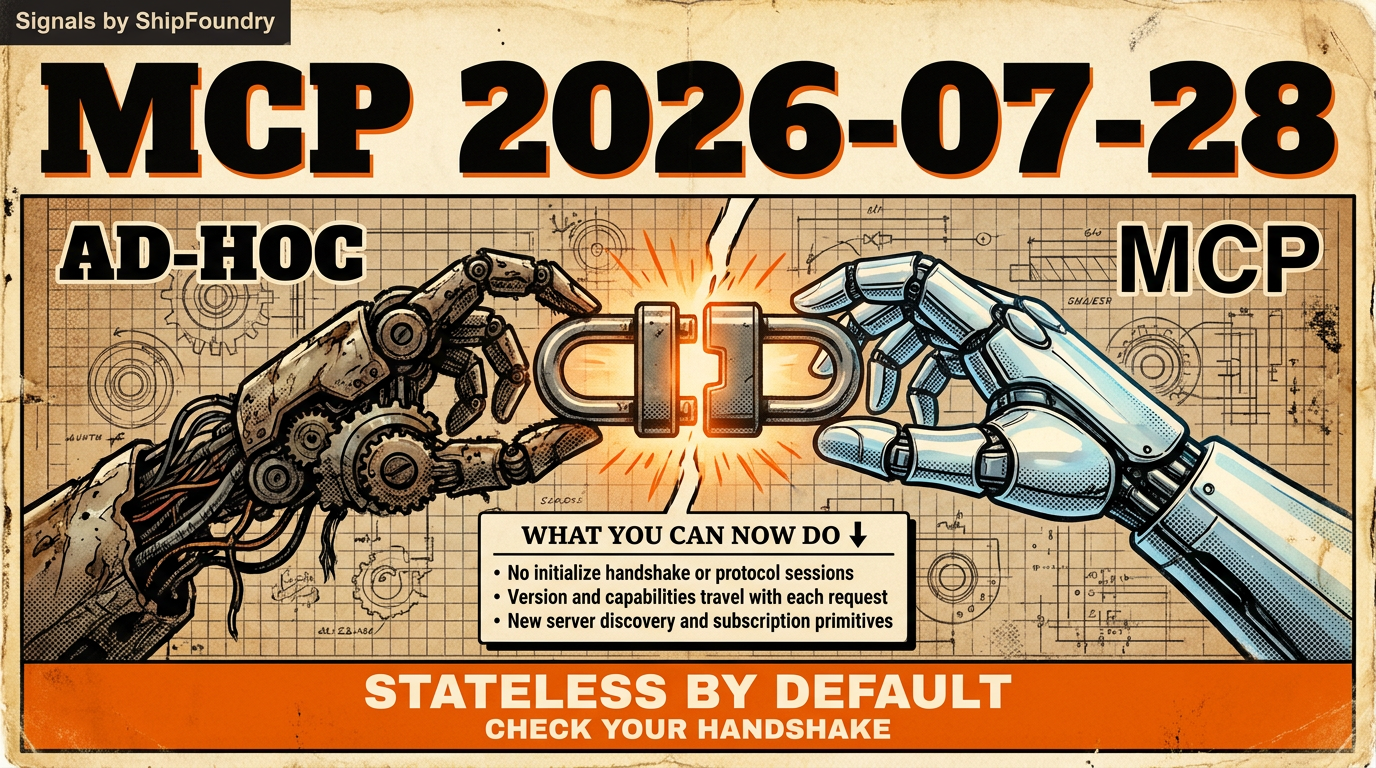
MCP's 2026-07-28 stable revision removes protocol sessions and the initialize handshake, then moves version and capability context onto every request. That can simplify horizontally scaled services, but it is a compatibility migration for clients, servers, and SDKs built around the previous lifecycle.
What Changed
- Protocol-level sessions and the Mcp-Session-Id header are removed from Streamable HTTP. Stateful workflows must use explicit server-minted handles passed as normal arguments.
- The initialize and notifications/initialized handshake is removed. Every request now carries protocol version and client capabilities in _meta.
- Servers must implement server/discover to advertise supported versions, capabilities, and identity.
- A new subscriptions/listen method replaces the old HTTP GET stream and resource subscribe and unsubscribe methods.
- Tasks move out of the core protocol into an official extension, and multi-round-trip requests replace several server-initiated request patterns.
- SSE resumability and message redelivery are removed; clients must retry broken in-flight requests with a new request ID.
Who Should Care
- Teams that own an MCP client, server, gateway, proxy, or SDK integration.
- Services that route by Mcp-Session-Id, depend on sticky sessions, or keep connection-affine state.
- Implementations using initialize, notifications/initialized, HTTP plus SSE, Roots, Sampling, Logging, or core Tasks.
Who Should Not Care
- Products with no MCP client or server surface.
- Teams whose vendor SDK fully absorbs protocol negotiation and compatibility, though they should still verify the SDK's support matrix.
- Builders looking for a new end-user feature rather than a protocol migration.
The Verdict
This is a real infrastructure unlock and a breaking migration, not a cosmetic spec bump. Stateless requests and explicit discovery can simplify scaling and routing, but only after compatibility is proven. Audit the exact SDK and wire behavior first, then plan dual-protocol support or a coordinated cutover.
Included In
July 2026 Signals: 8 Stack Changes Worth Your AttentionTake This To Your Agent
Copy a ready-to-paste investigation handoff that asks your coding agent to check this update against your product and recommend what to do next.