Signals
Trigger.dev 4.5 Makes Agent Conversations Survive Crashes and Redeploys
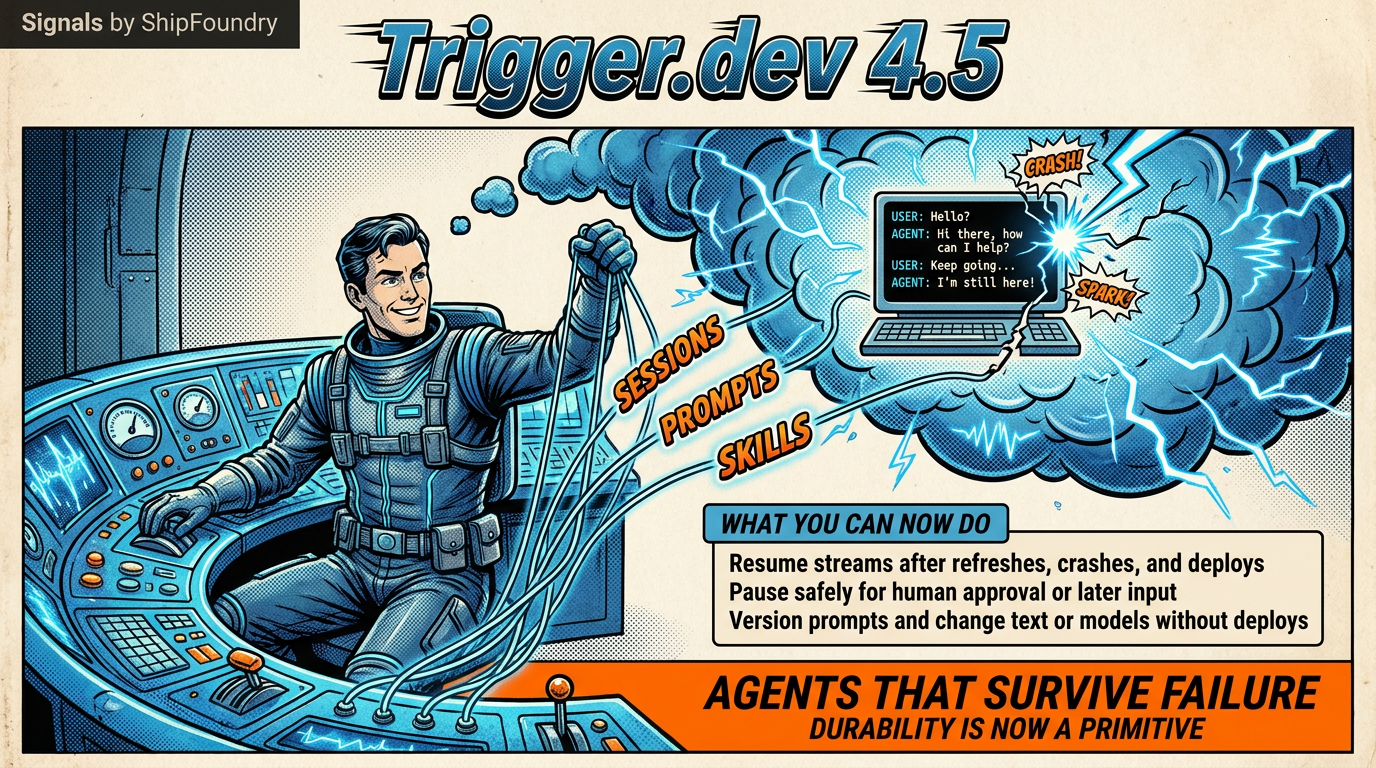
Trigger.dev turned fragile chat routes into durable agent runs. In 4.5, chat.agent, Sessions, and AI Prompts are generally available: conversations can reconnect after failures or deployments, wait safely for human approval, and use versioned prompts that teams can change without shipping code.
What Changed
- chat.agent runs a Vercel AI SDK conversation as one durable, long-lived task keyed by chatId. After refreshes, disconnects, redeploys, idle timeouts, or crashes, the run resumes and its stream reconnects from the last available chunk.
- Sessions are durable bidirectional channels keyed by a stable externalId. Their input and output streams can span suspends, crashes, redeploys, and multiple runs, making them useful for agent inboxes and approval workflows.
- AI Prompts are defined in code and versioned on deploy. Teams can override prompt text or the model from the dashboard by environment, and each generation links back to its version, usage, cost, and latency.
- Human approval, stop-generation, mid-run steering, and context injection can remain pending durably instead of depending on one browser tab or request staying alive.
- useTriggerChatTransport connects AI SDK useChat to Trigger.dev Realtime without a custom chat API route. Dev branches also isolate parallel Trigger.dev sessions for separate worktrees and coding agents.
Who Should Care
- Teams shipping customer-facing agents where a lost process, deployment, or browser connection can lose a task or customer interaction.
- Builders maintaining their own queues, retries, transcript streams, reconnection logic, approval state, or prompt registry.
- Teams already using Trigger.dev or Vercel AI SDK that want a supported path from a chat demo to a durable production workflow.
Who Should Not Care
- Products making short, stateless model calls that already complete reliably inside a normal request.
- Teams already using a durable workflow system that provides equivalent recovery, streaming, approval, and observability primitives.
- Builders unwilling to make Trigger.dev part of the agent execution control plane without first validating pricing, operations, data handling, and migration cost.
The Verdict
This is not another claim that an SDK makes agents intelligent. It makes the difficult operational layer, durable execution, recovery, reconnectable streams, human pauses, and prompt versioning, available as product infrastructure. For teams building long-lived interactive agents, that can eliminate a meaningful amount of custom machinery. Evaluate it against the failure modes and glue code you actually own before replacing a working runtime.
Included In
July 2026 Signals: 8 Stack Changes Worth Your AttentionTake This To Your Agent
Copy a ready-to-paste investigation handoff that asks your coding agent to check this update against your product and recommend what to do next.